Certified Collision Shop
Certified Collision Repair and Body Shop in Valley Stream, NY
Macarthur's body shop at 170 East Lincoln Avenue in Valley Stream repairs collision damage on every make and model, holds manufacturer certifications from Honda, Acura, Nissan, Infiniti, Hyundai, Kia, Mazda, and Chrysler, Dodge, Jeep, and Ram, and is I-CAR Gold Class. Our own tow trucks bring the car in, we write the estimate, and we handle the insurance claim. Call 516-362-5350 or stop in during shop hours.
Certifications and reviews
The Certifications on the Shop Wall, and What Drivers Say About Macarthur on Google
A body shop's proof is on its wall. Macarthur holds certifications from Honda and Acura, Nissan, Infiniti, Hyundai, Kia, Mazda, and Chrysler, Dodge, Jeep, and Ram, is I-CAR Gold Class, is an OEC certified provider, and belongs to the MetLife and Hanover direct repair programs. Every plaque is photographed on this site.
I got locked out my car on a cold snowy night and Alex came and unlock my car. He was very quick and professional. I would definitely use this towing company again.
Great timing and professionalism. The tow truck driver Carlos was experienced and helpful. I would recommend this company and Carlos to anyone.
Not the usual experience with a towing company. Everyone that I spoke to was polite and respectful and they towed my car with care. Hopefully I never need my car towed again, but if I do, this is who I will be using!
- 16Certifications on the shop wall
- I-CARGold Class training recognition
- 1,800+Google reviews, 5.0 average as of Oct 2026
- LicensedDMV # 7110205 · DCA # 1389419
- 1 ShopTow fleet and body shop, Valley Stream
- 24/7Our own trucks bring the car in
The Google reviews below come from the towing side of the business, because that is where most drivers meet Macarthur first: a lockout, a breakdown, a tow after an accident. The body shop is where many of those cars end up next. If the shop has repaired your car, a few words on Google help the next driver who is standing in a parking lot deciding where to send it.
Drive one of the certified brands? Your repair follows the factory procedure.
- Collision Repair
- Auto Body Shop
- Body Shop
- Auto Painting
- Paint Matching
- Frame Repair
- Unibody Repair
- Auto Glass
- Windshield Replacement
- Bumper Repair
- Dent Repair
- Panel Replacement
- Insurance Claims
- Direct Repair
- Certified Body Shop
- I-CAR Gold Class
- Honda Certified
- Nissan Certified
- Hyundai Certified
- Kia Certified
Why a Body Shop That Owns Its Tow Trucks Gets Your Car Back Sooner
Macarthur is a collision shop and a tow company under one roof in Valley Stream. The truck that recovers your car after an accident brings it straight to the repair bay, the same office writes the estimate and talks to your insurer, and nobody has to find a second company or pay a second tow.
Most of the delay in a collision repair happens before anyone touches the car. It sits at a tow yard until the insurer inspects it. Then it waits for a second tow to a shop. Then the shop writes an estimate the adjuster has already written once. Macarthur cuts all of that out because the tow and the shop are the same business. A car that comes in on one of our accident recovery trucks is in the shop's lot the same day, and the estimate, the photographs, and the insurer's inspection happen in the place the car is going to be fixed.
The shop handles every make and model, domestic, import, luxury, hybrid, and electric. The technicians work from the manufacturer's published repair procedures, which is what the certifications on the wall require, and the paint shop matches the factory color code and blends it into the neighboring panels so there is no line. You can bring a car in on its own wheels during shop hours, Monday through Friday 8 AM to 5 PM and Saturday 9 AM to 12 PM, or call 516-362-5350 any hour and have it towed in.
Below is every body shop service we offer, each with its own page. Further down this page: how the estimate is written, how the insurance claim runs and why you choose the shop, what each certification means for your car, the repair work itself from bumpers to frames, parts, timelines, and pickup.
Every body shop service, each with its own page
Collision Repair
From fender benders to major damage, repaired to pre-accident condition.
Auto Body Repair
Dents, scrapes, rust, and panel replacement.
Auto Painting
Spot repair to full repaints, matched to the factory color.
Frame Repair
Frames pulled back to straight and true.
Auto Glass Replacement
Windshields, door glass, and back glass replaced.
Bumper Repair
Cracked, scraped, or pushed-in bumpers repaired or replaced.
Dent Repair
Door dings, hail, and creased panels.
Insurance Claim Repair
You choose the shop. We handle the claim.
Can't drive it in? Our own truck brings it to the shop.
How a Collision Estimate Is Written at Macarthur, and Why the First Number Is Rarely the Last
A Macarthur estimate is written in person by the shop, itemized line by line, with photographs. It covers what is visible on the day you bring the car in. Once the damaged panels come off and the hidden damage behind them is exposed, the shop documents it and submits a supplement. That is normal, and covered damage is covered whether it was visible on day one or not.
People are suspicious of estimates, and they should be. Here is exactly how ours works so you can see where every number comes from.
The walk-around and the first write-up
An estimator looks at the car with you, photographs every damaged area and the undamaged panels next to it, pulls the vehicle's build data by VIN, and writes an itemized estimate: each part by name and part number, labor by operation, paint by panel, and materials. You get a copy. If you are paying out of pocket, we mark which lines are safety or structural and which are cosmetic and can wait.
What an insurance estimate from photos misses
Many insurers now write a first estimate from photographs you upload. That number is a starting point, not a ceiling. A photo cannot see a cracked bumper reinforcement behind an intact cover, a bent radiator support behind a bent fender, or a kinked frame rail behind a quarter panel. Our estimate is written from the car, and the difference is documented when the teardown happens.
Teardown and the supplement
Once the car is approved for repair, the damaged parts come off and the structure behind them is inspected and measured. Anything found that was not in the original estimate is photographed, written up as a supplement, and sent to the adjuster. The insurer reviews it and approves the covered items. This happens on most repairs beyond a scraped bumper, and it is not a dispute; it is how the process is designed. The insurance claim repair page goes through supplements step by step.
What the estimate will not do
It will not quote low to get the car in the door and climb once the car is on the lift. If a number changes, it changes because something was found and photographed, and you see the photograph. And if the car is not worth repairing, the estimate says so plainly rather than running up a bill on a total loss.
Stop in during shop hours for an itemized estimate. No appointment needed.
Your Right to Choose the Body Shop in New York, and How the Insurance Claim Runs From Day One
Under New York Insurance Law section 2610, your insurer cannot require you to use a particular repair shop. Tell the adjuster the car is at Macarthur Auto Body and Towing, 170 East Lincoln Avenue, Valley Stream. From there the shop writes the estimate, hosts the inspection, handles supplements, bills the insurer directly, and you pay only your deductible.
The single most common question the office gets is some version of "my insurance company says I have to use their shop." You do not. Here is how the claim actually runs when the car is at Macarthur.
Day one: the claim and the location
Report the claim to your insurer, or to the other driver's insurer if they were at fault. Give them the claim details and the car's location: Macarthur Auto Body and Towing in Valley Stream. If the insurer suggests one of their network shops, you can say no. They can recommend; they cannot require. If they say a network shop would be faster, ask them to put the reason in writing, and then call us; it is almost never true.
The inspection at our shop
The adjuster inspects the car where it sits, in our lot, or reviews our estimate and photographs remotely. Either way the car does not move. There is no tow to an inspection center and back.
Network shops, direct repair programs, and why it matters who the shop answers to
A direct repair program shop agrees to the insurer's labor rates, parts rules, and processing targets in exchange for referrals. That can be fine. It can also mean aftermarket parts where factory parts are called for and repair steps that get skipped to hit a cycle time. Macarthur is a member of the MetLife Concierge Repair and Hanover Express Claims programs, which you can see on the certifications page, and we work with every other carrier that writes policies in New York. On every job, the shop answers to the owner of the car.
Deductibles, rental cars, and who pays what
If your own collision coverage pays, your deductible is your share and it is due when you pick up the car. If the other driver's liability coverage pays, there is usually no deductible for you. If your policy has rental coverage, your insurer arranges the rental and we coordinate the dates so you are not paying for days the car is not ready. We tell you which situation you are in before the work starts.
Total loss, and what to do if you disagree
If the repair cost approaches the car's value, the insurer may declare a total loss and offer a settlement. You can dispute the valuation with comparable listings, and in some cases you can keep the car and have it repaired. Our itemized estimate supports either conversation. We will tell you honestly whether a repair makes sense for the car you have.
Tell your adjuster the car is at Macarthur in Valley Stream. We take it from there.
What Each Certification on the Wall Means for the Car in Your Driveway
A manufacturer certification means the automaker audited the shop's equipment, training, and procedures and approved it to repair that brand to factory standards. Macarthur is certified by Honda and Acura, Nissan, Infiniti, Hyundai, Kia, Mazda, and Chrysler, Dodge, Jeep, and Ram, holds I-CAR Gold Class training recognition, is an OEC Collision Performance Network certified provider, and belongs to the MetLife and Hanover direct repair programs.
Modern cars are built from high-strength steel, aluminum, bonded and riveted panels, and a web of cameras, radar, and sensors. Each manufacturer publishes exact procedures for repairing them, down to which welds are allowed where and which parts must be replaced rather than straightened. A certified shop has the tools and the trained technicians to follow those procedures, which is what keeps the car's crash protection, its warranty, and its resale value intact. Here is what each plaque represents.
Honda and Acura Certified Collision Repair Facility
American Honda audited the shop and awarded Certified Collision Repair Facility status, renewed on a cycle. For a Honda or Acura owner it means the repair follows Honda's body repair manual, uses the equipment Honda specifies, and is done by technicians trained on Honda's procedures.
Nissan and Infiniti Collision Repair Network
Certified in the Nissan Collision Repair Network and separately certified for Infiniti. Nissan and Infiniti vehicles are repaired to Nissan's specification, including the driver-assistance systems that need recalibration after a front or rear repair.
Hyundai and Kia Certified and Recognized
Macarthur is both a Hyundai Certified Collision Center and a Hyundai Recognized Center, and holds the same pair from Kia. The certification covers tools, training, and procedures; the recognition lists the shop in the brand's collision repair program.
Mazda Collision Network Certified Center
Approved by Mazda North American Operations to repair Mazda vehicles with the correct equipment, parts, and procedures.
Chrysler, Dodge, Jeep, and Ram Certified, and Mopar Recognized
Certified by FCA US for Chrysler, Dodge, Jeep, and Ram collision repair, and recognized in the Mopar collision program. Ram trucks and Jeeps make up a lot of Long Island driveways, and this is the certification that covers them.
I-CAR Gold Class
I-CAR is the collision industry's training body, and Gold Class is its highest shop-level recognition. It requires every role in the shop, estimators, body technicians, painters, to complete and keep up role-specific training on current vehicles and procedures. It is the credential that insurers and manufacturers both look for.
OEC Collision Performance Network
OEC connects certified shops to manufacturer parts and repair information. Being a certified provider in the network means the shop sources original parts and procedures through the manufacturer channel rather than guessing.
MetLife Concierge Repair and Hanover Express Claims
Direct repair program memberships with two carriers. For MetLife and Hanover policyholders it means a faster approval path; for everyone else it means the shop already works at the documentation standard insurers expect.
If your brand is not on the list
The shop repairs every make. For brands without a Macarthur certification, the technicians still work from that manufacturer's published repair procedures, and the I-CAR training applies to every car in the bay. Every plaque, with a photograph and a plain-English explanation, is on the certifications page.
The plaques, photographed at the shop
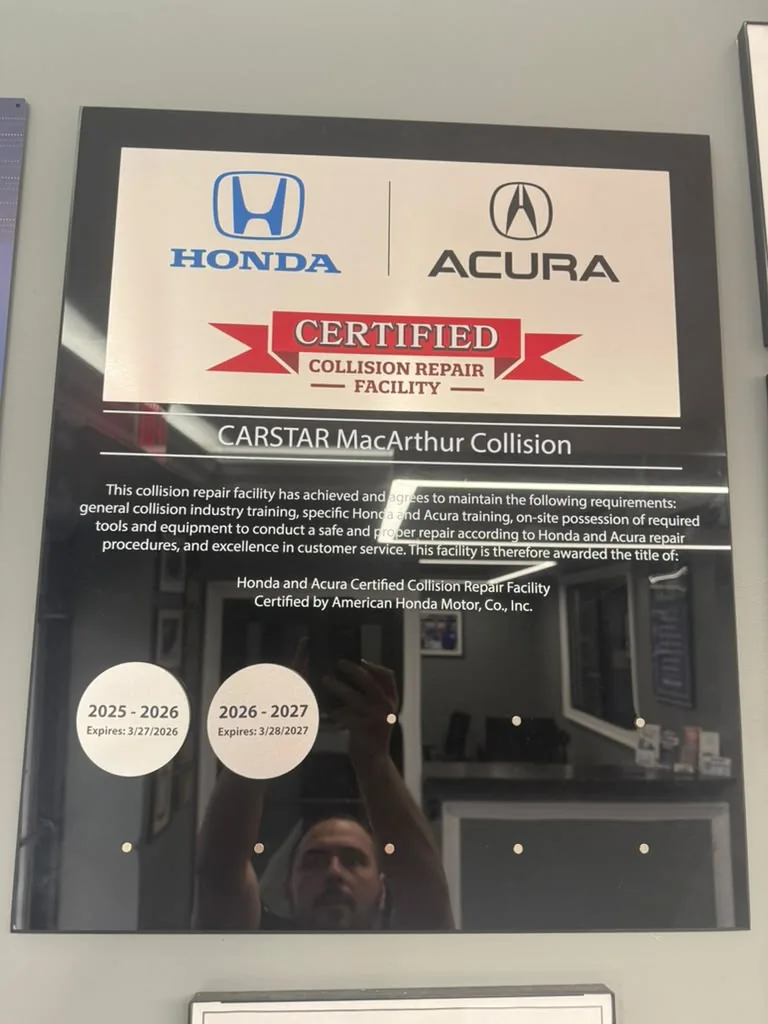
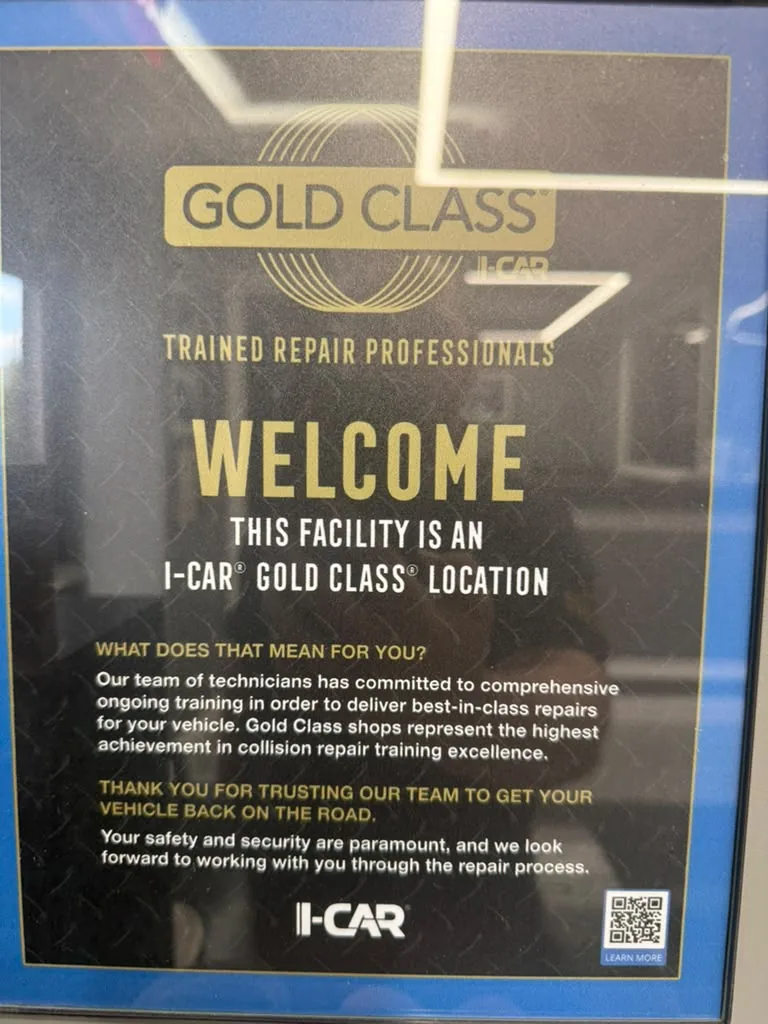
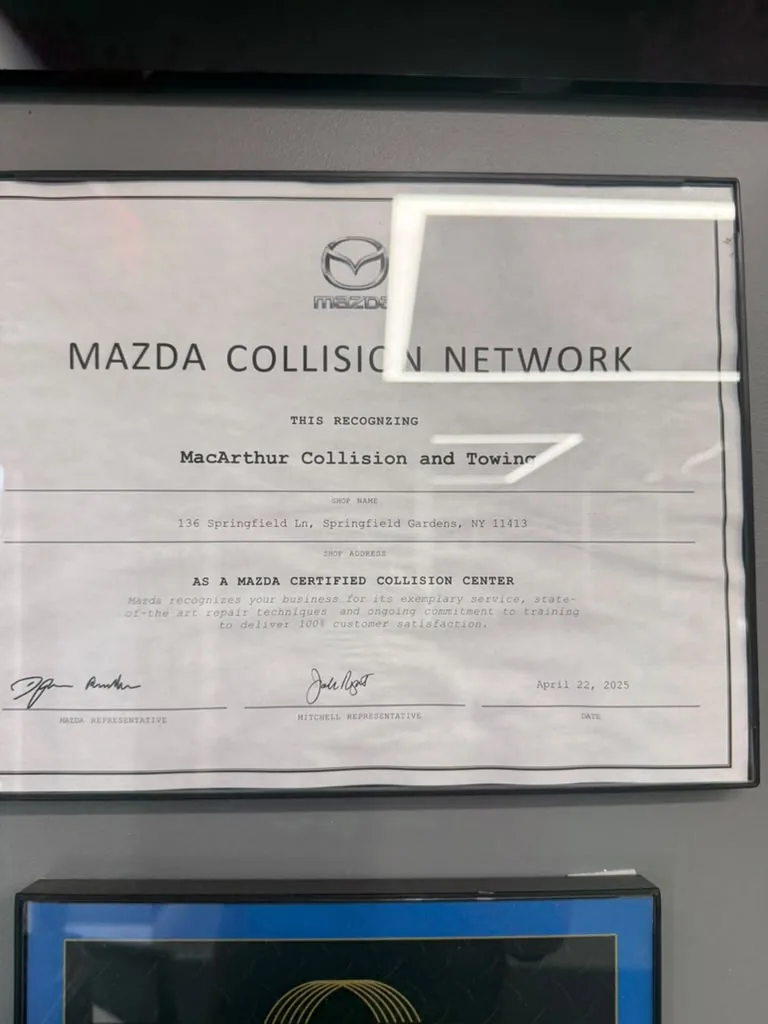
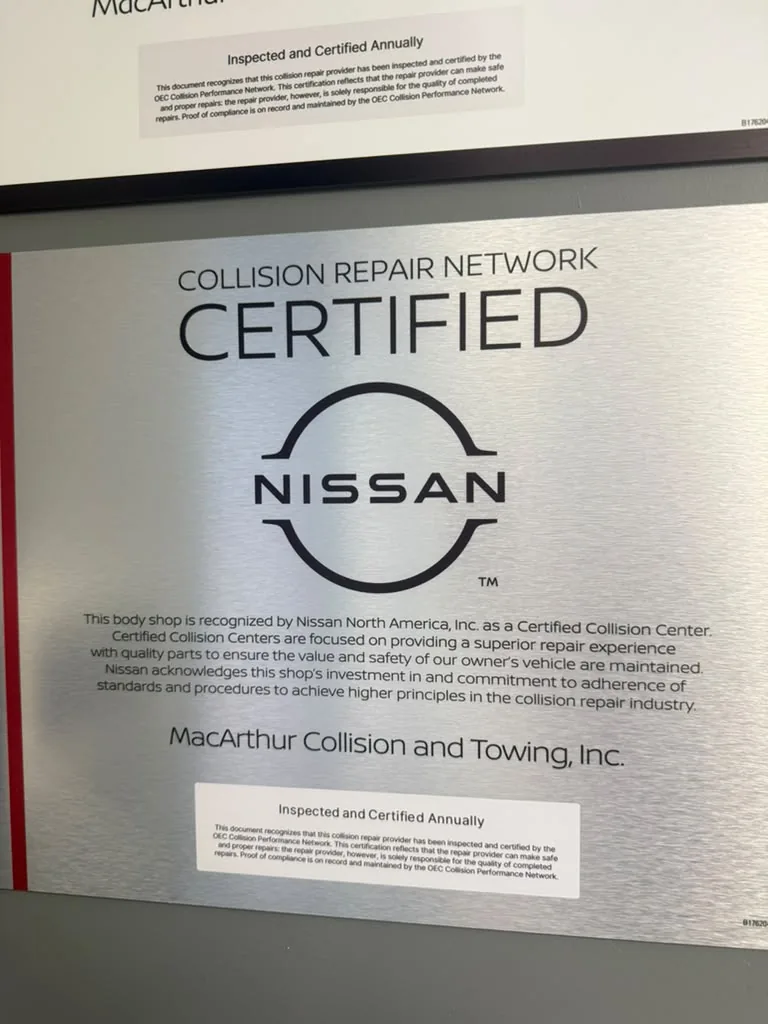
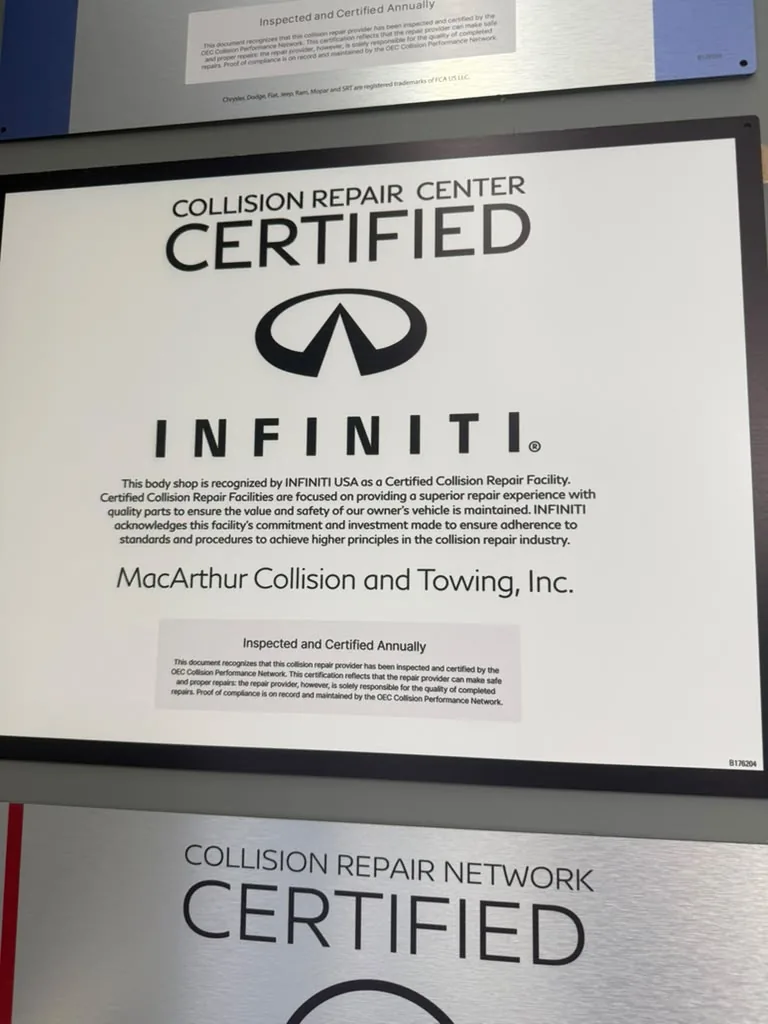
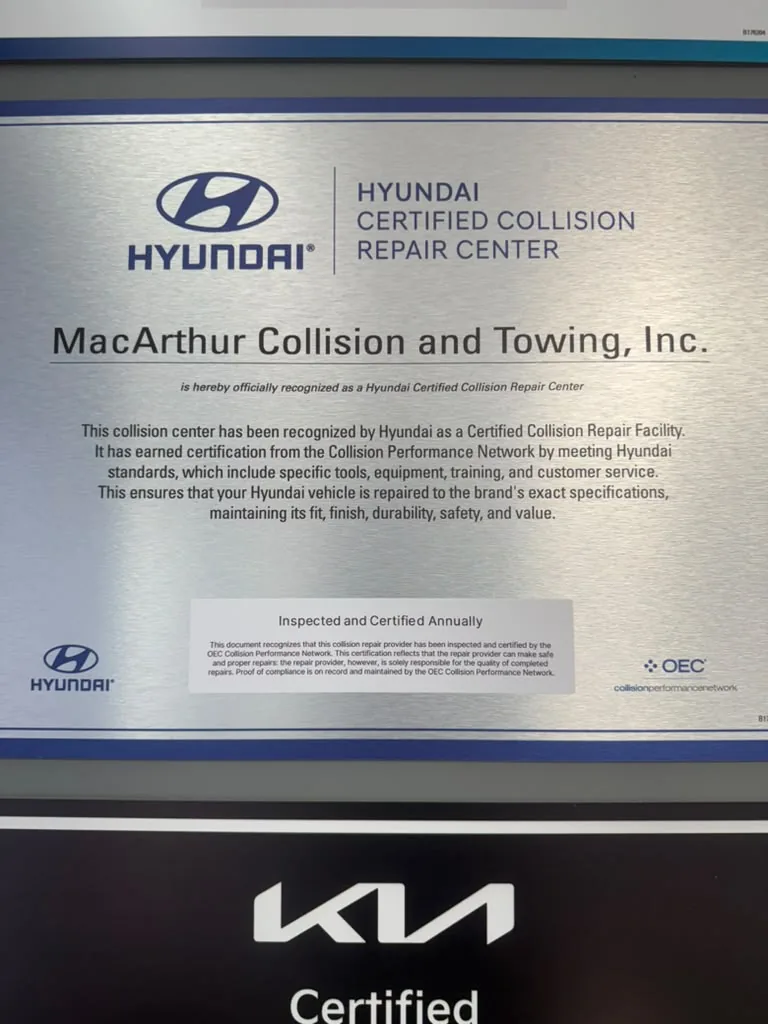
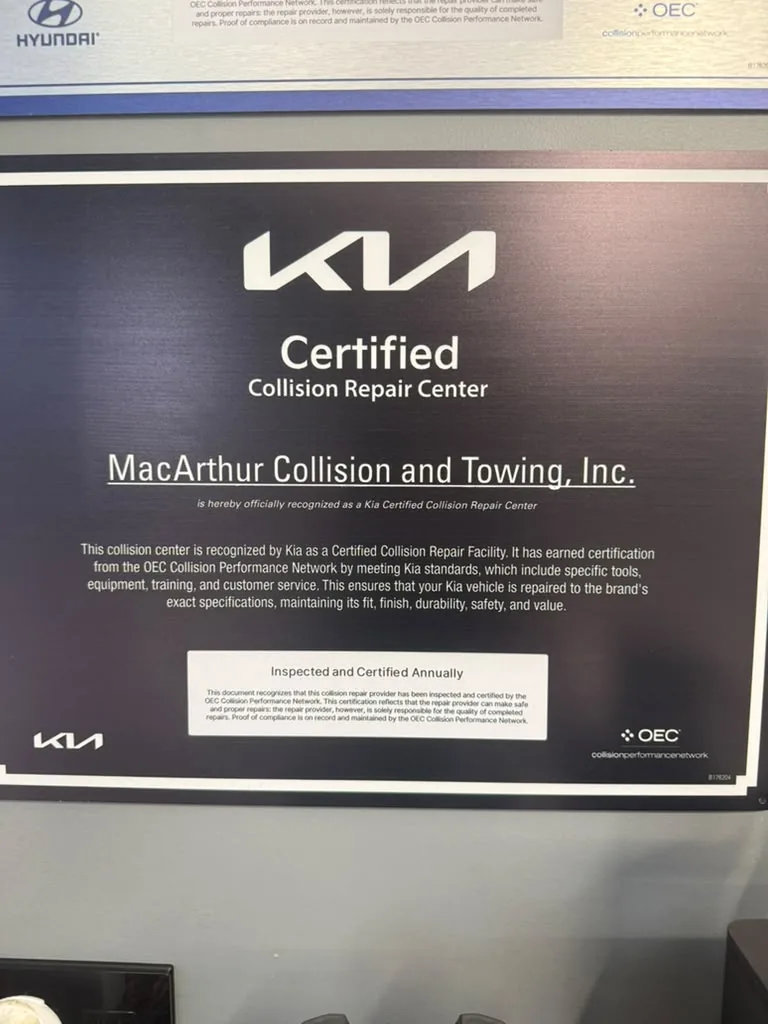
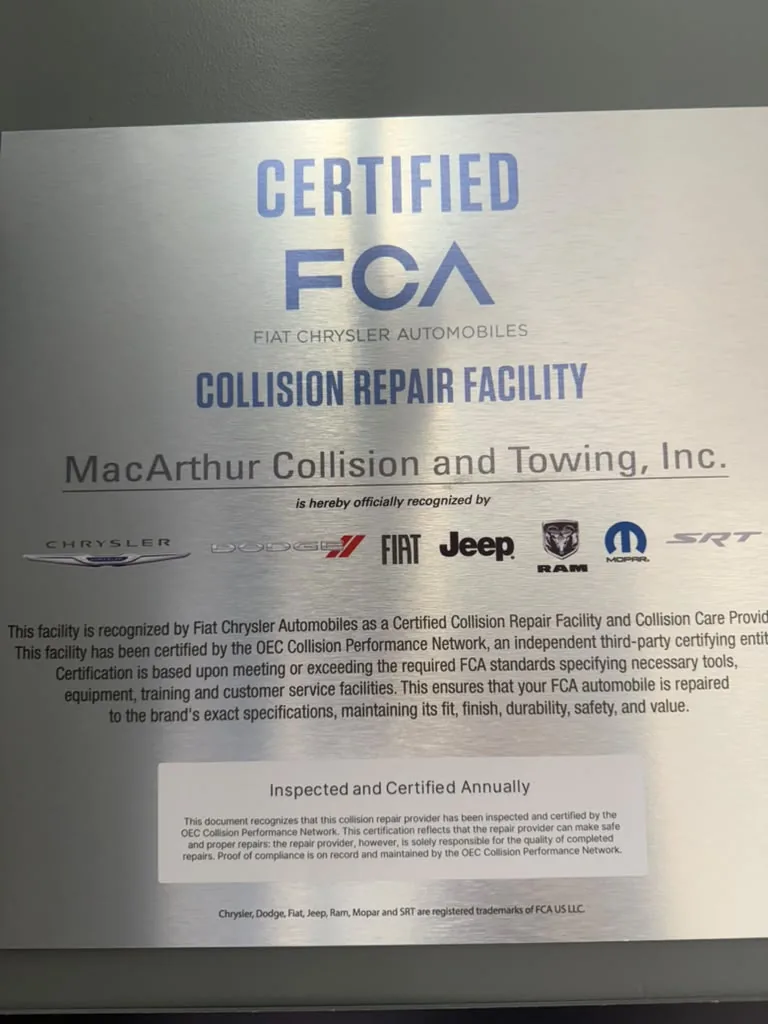
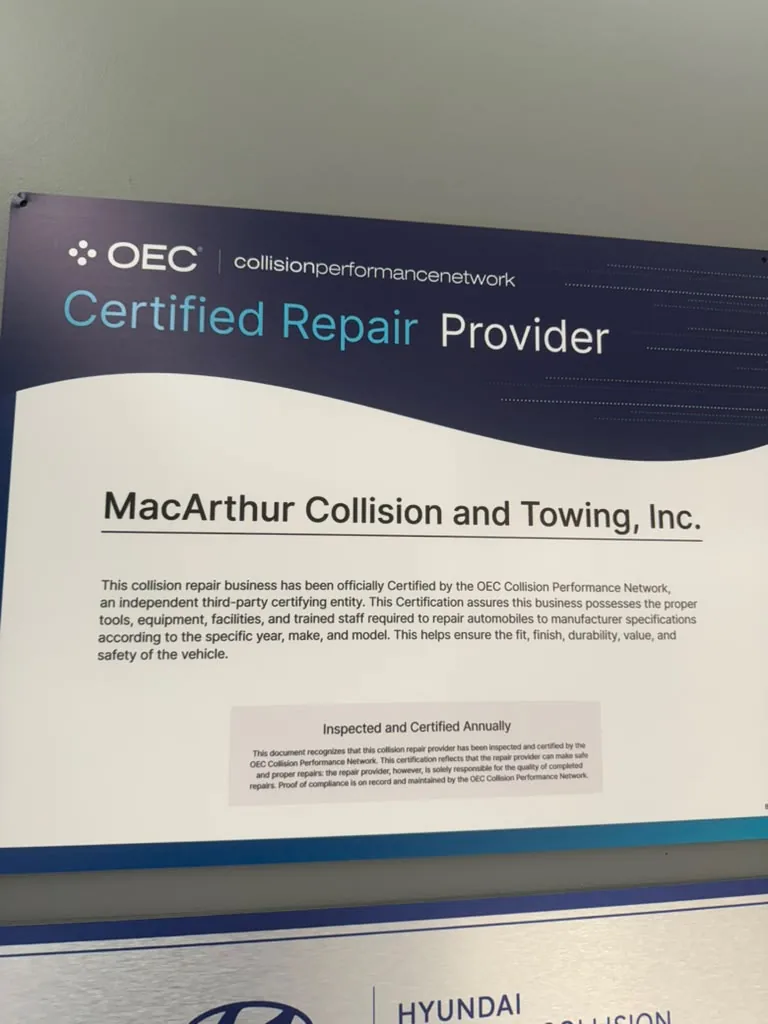
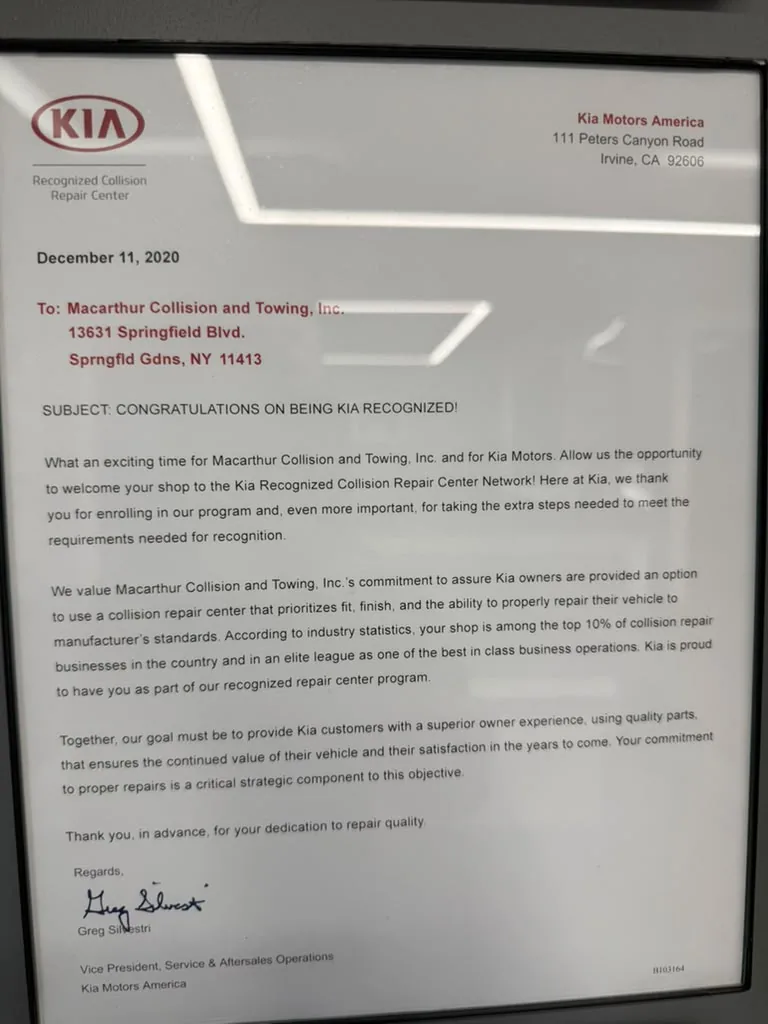
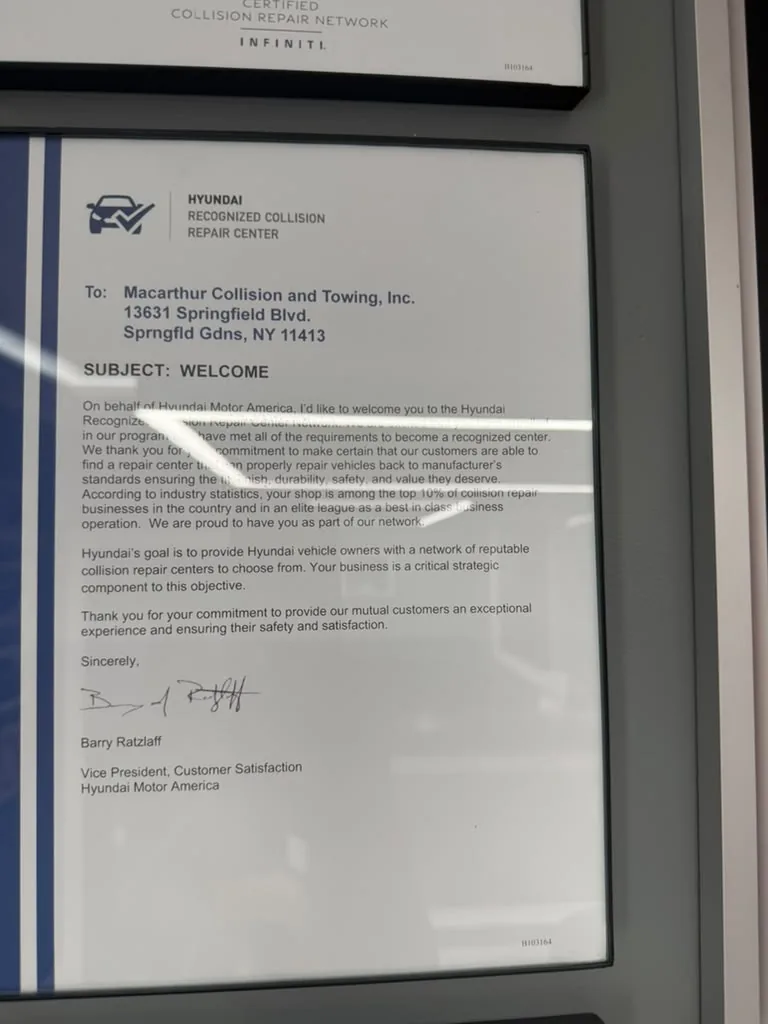
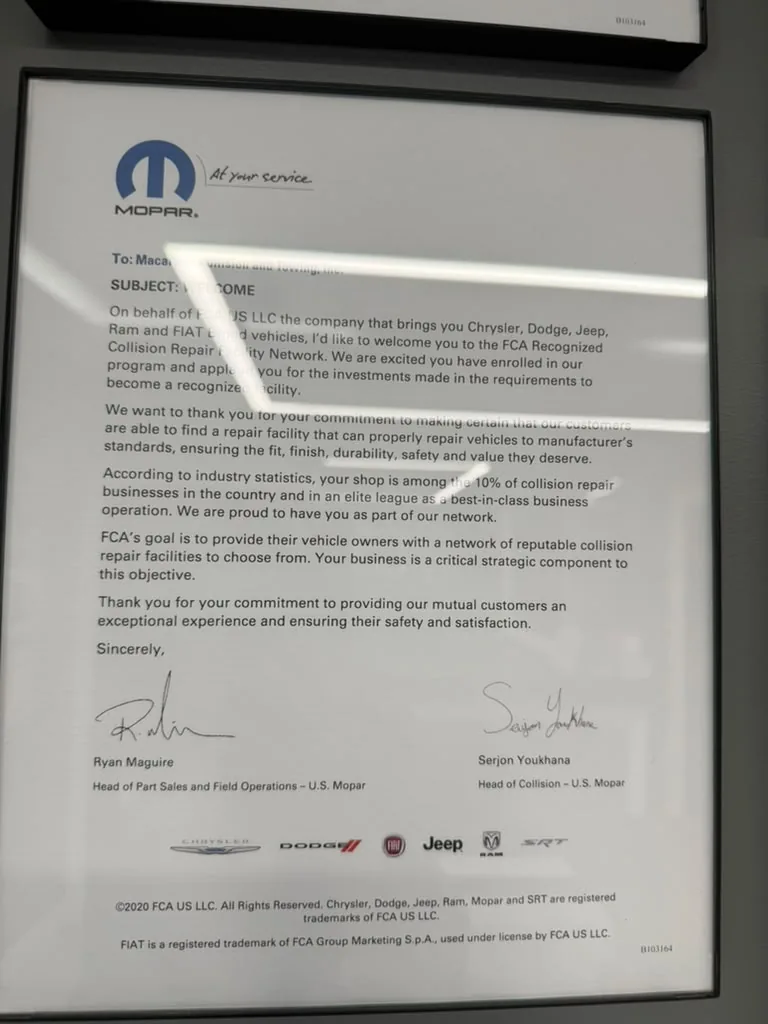
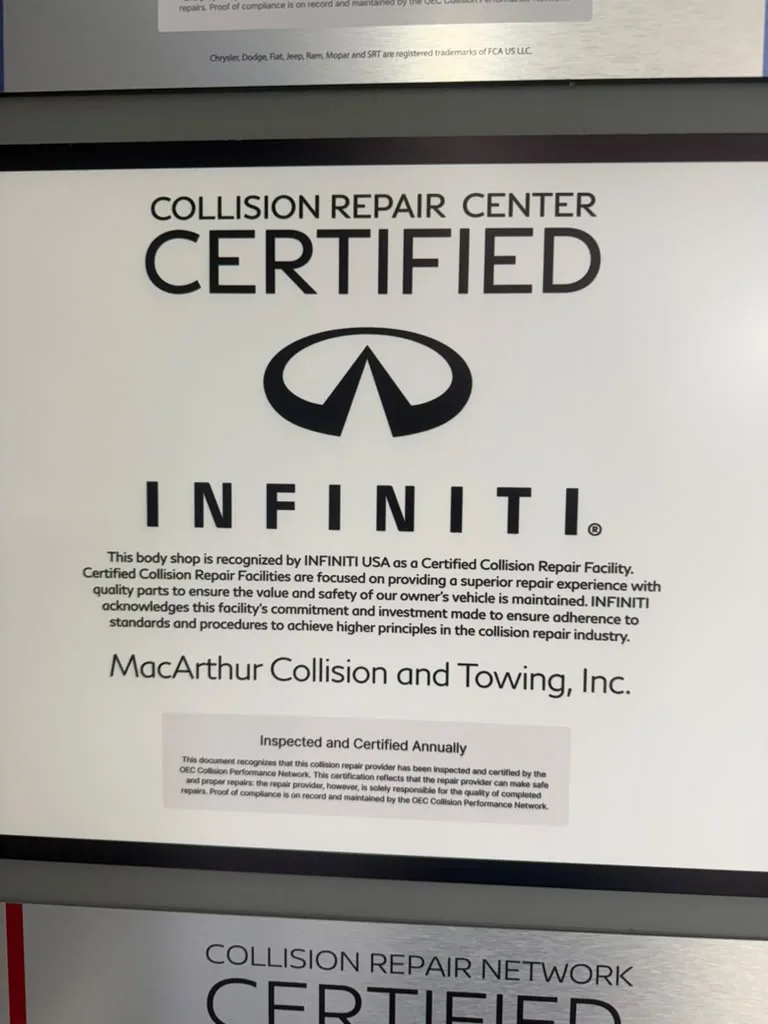
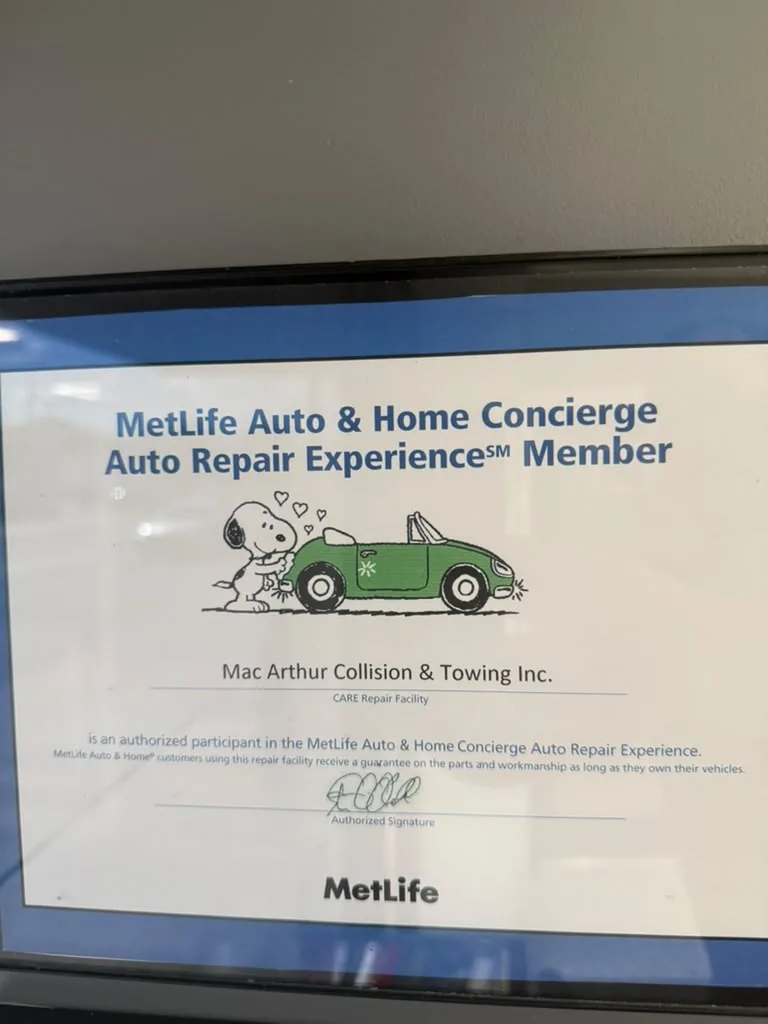
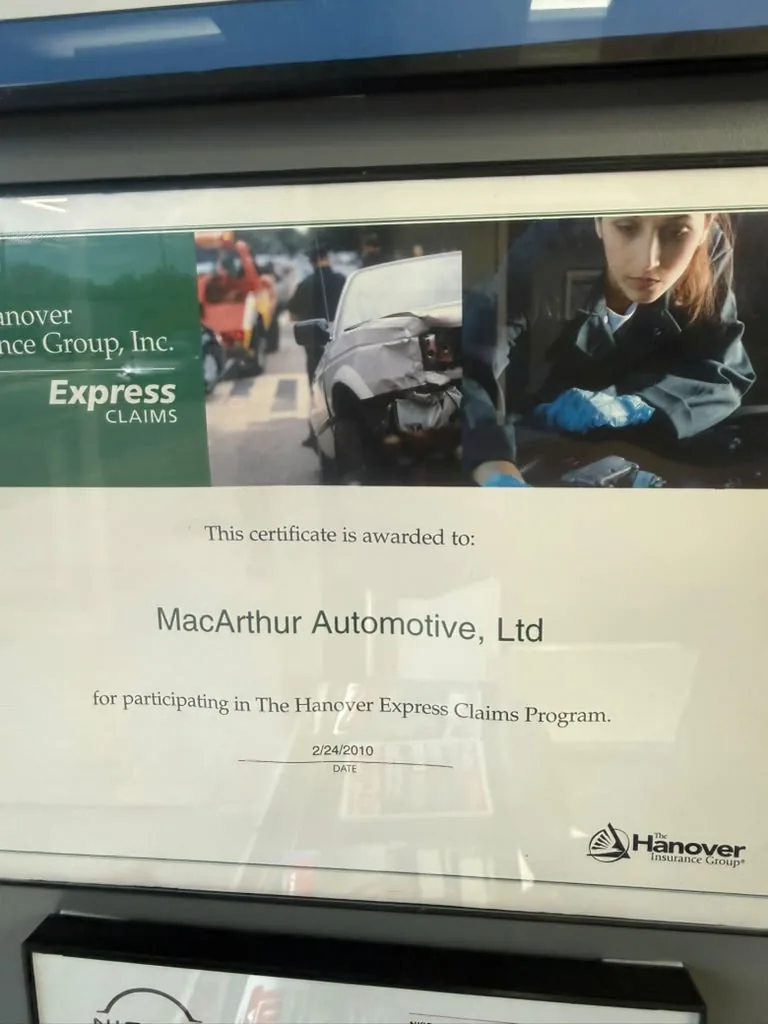
Ask to see the plaques when you drop the car off. They are on the wall.
Collision Repair From a Fender Bender to Structural Damage, Done to the Manufacturer's Procedure
Collision repair at Macarthur covers everything from a scraped bumper cover to a car with a bent frame rail and deployed airbags. Each repair is planned from the manufacturer's procedures: what gets repaired, what gets replaced, how the structure is measured, and which sensors and cameras need recalibration before the car goes back on the road.
A collision repair is a sequence, and the order matters. Here is what happens to the car from the time it is approved to the time it is painted.
Disassembly and blueprinting
The damaged area is taken apart to the point where every affected part can be seen. The estimator and the technician build the repair plan from that, not from the outside of the car. This is where the supplement comes from and where surprises are supposed to be found, not after the car is painted.
Repair or replace, and who decides
A dented steel fender can often be repaired. A kinked high-strength steel rail cannot, and the manufacturer says so in writing. An aluminum hood with a crease may be a replacement because aluminum does not move back the way steel does. The decision for each part follows the manufacturer's rules first and cost second, and the estimate shows which is which.
Structure, measurement, and the frame bench
Any hit hard enough to move the structure gets measured against the manufacturer's specification before and after repair. The frame repair page explains unibody and full-frame straightening and why the after-measurement is the one that matters.
Welding, bonding, and riveting
Replacement structural panels are attached the way the manufacturer specifies: spot welds, MIG brazing, structural adhesive, or self-piercing rivets, depending on the metal and the location. Using the wrong method on high-strength steel weakens it, which is why the procedure is followed and not improvised.
Sensors, cameras, and calibration
Lane cameras behind the windshield, radar in the grille and bumpers, parking sensors in the covers, blind-spot modules in the quarters. After a repair that disturbs any of them, the system is recalibrated so it sees the road the way it did from the factory. This is part of the repair on vehicles that have these systems, and it is on the estimate.
Then paint, reassembly, and the final check
Once the structure and the panels are right, the car goes to the paint shop, is reassembled with its trim, lights, and sensors, and is inspected and test driven before you are called. The collision repair page has more on what is included.
Car in an accident? Bring it in or have our truck bring it.
Paint Matching, Blending, and Why a Good Repair Is the One You Cannot Find
Macarthur's paint shop reads the factory color code from the vehicle, mixes the color to that formula, sprays test cards to match the car's actual shade, and blends the new paint into the adjacent panels so the eye cannot find where the repair stops. Clear coat and polishing finish the job.
Paint is where a body shop's reputation is made or lost, because it is the only part of the repair you can see. Here is why matching is harder than it sounds and how the shop gets it right.
The color code is a starting point, not the answer
Every car has a paint code on a label in the door jamb or under the hood. That code points to a formula, but the same code can have several factory variants, and every car's paint has shifted a little with sun and age. The painter mixes the formula, sprays a test card, and holds it against the car in daylight. If it is off, the mix is adjusted until it is not.
Blending into the next panel
Even a perfect match looks wrong if it stops at a hard edge, because the eye compares the two panels side by side. So the new color is faded into the neighboring panel, and the clear coat covers both, which is why an estimate for a fender often includes blend time on the door. That is not padding; it is how the repair disappears. The auto painting page covers spot repairs, panels, and full repaints.
Metallics, pearls, and three-stage paint
Metallic flake and pearl change appearance with the angle of light, and tri-coat whites and reds are sprayed in layers over a base. These take more test cards and more blend, and the estimate reflects that for the color the car actually has.
Clear coat, curing, and care
The clear coat is what you touch and what protects the color. It is applied over the blended base, cured, and polished. Ask the office for care instructions when you pick the car up; fresh paint has a period where it should not be waxed or run through a brush car wash, and we will tell you how long for the product used on your car.
Scraped a panel? Bring it in and see the match before you commit.
Frame and Unibody Straightening: Measured Before the Pull and Measured Again After
A car that was hit hard enough to move its structure is set on a frame bench, measured against the manufacturer's dimensions, pulled back to specification with controlled hydraulic force, and measured again. The after-measurement is printed and kept with the repair file. A car that is not straight will not track, will not wear tires evenly, and will not protect you the same way in the next collision.
Most cars on the road today are unibody: the body shell is the frame. Pickups and large SUVs still have a separate ladder frame. Both can be bent, and both can be straightened, within the limits the manufacturer sets.
The signs that structure moved are easy to miss from the outside. A door that needs a lift to close. A hood or trunk gap wider on one side. A steering wheel off center with the car going straight. Tires wearing on one edge after an accident. Any of these after a hit means the car gets measured, and the frame repair page lists what the technician checks.
On the bench, the technician anchors the car, takes measurements at the manufacturer's reference points, and compares them to the published specification. Pulls are made in small increments with the measuring system live, so the structure is moved back rather than overcorrected. Where the manufacturer says a section is not repairable, because high-strength steel loses its strength when bent and re-bent, the section is replaced at the factory cut line and attached by the factory method. After the pull, the suspension is checked and the car is aligned, because a straight body on a bent control arm is still a car that pulls.
Doors not closing right after a hit? Have it measured before you drive it.
Windshield and Auto Glass Replacement, With a Collision Repair or on Its Own
Macarthur replaces windshields, door glass, quarter glass, and rear glass with defroster, as part of a collision repair or as a standalone job. Glass is often covered under comprehensive insurance with a separate deductible, and the shop bills the insurer directly. Windshields with a camera behind them are recalibrated after replacement.
A windshield is a structural part of a modern car. It holds the roof up in a rollover and gives the passenger airbag something to push against. That is why it is bonded in with urethane to a prepared frame rather than set in a gasket, and why the cure time before the car can be driven matters. The auto glass replacement page has the details for each type of glass.
If your car has lane-keeping or automatic braking, the camera for it is mounted to the windshield. After replacement that camera is recalibrated so the system reads the road correctly, which is a step a glass-only shop may not do. A cracked windshield from a stone is usually a comprehensive claim with its own deductible, often lower than your collision deductible, and some New York policies carry no glass deductible at all; check yours, and we bill the carrier directly either way. Side and rear glass are tempered and break into pieces; those get vacuumed out of the door or trunk before the new glass goes in, so you are not finding cubes a year later.
Cracked windshield? Ask about your comprehensive deductible when you call.
Bumpers, Dents, Door Dings, and the Small Jobs Many Customers Pay for Themselves
Not every body job is an insurance claim. A scuffed bumper cover, a parking lot dent, a door ding, or a scraped quarter panel can be repaired at the shop for a written price, with the same paint match as a full collision repair. Macarthur writes the estimate the same way whether you or an insurer is paying, so you can decide which makes sense.
A lot of customers would rather pay for a small repair than file a claim and watch their premium move. The shop writes the estimate the same way either way and tells you honestly which lines are cosmetic.
Bumper covers. Scuffs and small cracks in a plastic cover can often be repaired and refinished. A cover that is split, deformed, or has broken tabs gets replaced. If the hit was hard enough to crack the reinforcement bar or a parking sensor behind the cover, those are replaced too. The bumper repair page explains how the shop decides between repair and replace.
Dents and dings. A door ding or shopping cart dent in a flat panel can be pulled and finished with paint only where the finish is broken. A sharp crease or a dent on a body line takes more work because the metal has stretched. The dent repair page covers what is repairable and what gets a new panel.
Scrapes, rust, and panels. Garage scrapes, rust bubbles at the wheel arch, a rocker panel that rotted from the inside, a quarter panel from a sideswipe. These fall under auto body repair and are priced per job after the estimator sees the car.
When to file and when not to. If the repair is close to your deductible, paying out of pocket usually makes sense. If it is well above it, or if another driver was at fault, a claim does. We will not tell you what to do with your policy, but we will give you the number you need to decide.
Small job? Stop in for a written price. No claim required.
OEM, Aftermarket, and Recycled Parts: What Goes on Your Car and Who Decides
The estimate lists every part by type: new original equipment from the manufacturer, new aftermarket from another maker, or recycled original equipment from a salvage vehicle. Which type is used on a given part depends on the manufacturer's repair procedure, the insurance policy paying for the repair, and your own choice, and the shop explains each one before the parts are ordered.
Parts are where repair quality and repair cost meet, and it is worth understanding the three kinds before an adjuster or an estimator says a word.
Original equipment (OEM). The part the car was built with, from the manufacturer, through the dealer channel. It fits, it meets the manufacturer's crash standards, and for structural and safety parts it is often the only type the manufacturer's procedure allows. The OEC network membership on the wall is how the shop sources these.
Aftermarket. A new part made by another company to fit the car. Quality ranges from very good to poor. Some insurance policies specify aftermarket parts for cosmetic items on cars past a certain age, and New York requires the estimate to tell you when a non-original part is being used. If an aftermarket part does not fit or does not meet the standard, the shop says so and documents it for the insurer.
Recycled original. An original part taken from a salvage vehicle, usually for items like doors, hoods, and lamps on older cars. It is a factory part at a lower price, inspected before it goes on.
Your say. If you want original parts where the policy allows aftermarket, you can usually pay the difference; the estimate shows it. If you are paying out of pocket, you choose. Either way the type of every part is on the paper you sign, which is how it should be.
Want original parts on your car? Say so at the estimate.
How Long a Collision Repair Takes, and What Actually Slows One Down
The time a collision repair takes depends on how much is damaged, how quickly the insurer approves the estimate and any supplement, how long the parts take to arrive, and how many panels need paint. Macarthur gives you a realistic window once the car is torn down and the parts are ordered, and calls you when something changes it rather than letting you find out at pickup.
Nobody can honestly promise a number of days before the car is apart. What the shop can do is tell you where the time goes and keep you informed while it goes there.
Approval. The estimate goes to the insurer. Approval can be same-day or it can wait on an adjuster's schedule. A supplement after teardown goes through the same step. The shop pushes; it cannot approve for them.
Parts. Common parts for common cars arrive quickly. A structural part for a newer model, a specific trim's headlamp, or anything on a manufacturer backorder can wait weeks, and that is the single biggest reason a repair runs long. We order as soon as the plan is approved and tell you if something is on backorder.
Structure and calibration. A car that needs the frame bench and then sensor recalibration takes longer than one that needs a door skin. Both are done in sequence and neither is rushed.
Paint. Each panel is prepped, primed, sealed, based, cleared, cured, and polished. More panels and more blend mean more time in the booth.
What we do about it. We give you a window once the car is apart and the parts are ordered, update you if it changes, and coordinate the rental dates with your insurer so you are not paying for a car you do not need. If you need to reach the office, the number is 516-362-5350 and the hours are on the contact page.
Want to know where your car is in the process? Call the office.
Picking Up Your Repaired Car: the Walk-Around, the Paperwork, and the Deductible
When the repair is done, the office calls you. At pickup you walk around the car with us, in daylight when possible, check the repair against the estimate, settle the deductible or the out-of-pocket balance, and sign the release. Bring your license and the registration; if someone else is picking the car up, they need your written authorization.
The pickup is the last step and the one people are most anxious about, so here is exactly what it looks like.
The walk-around. You and a member of the shop look at the repaired area and the panels around it. Check the paint match in daylight, open and close the doors, hood, and trunk, and look at the gaps. If anything is not right, say so then; it is far easier to address while the car is still at the shop.
The paperwork. The final invoice shows every part by type and every operation, matching the estimate plus any approved supplement. If an insurer paid, you see what they paid and what is yours. If sensors were recalibrated, the calibration report is in the file.
The deductible and the balance. Your deductible is due at pickup if your own policy paid. If you paid out of pocket, the written price is the price unless a change was approved by you along the way. Ask the office about payment when they call you.
Who can pick it up. You, with ID. Or someone you authorize in writing, with their ID and your authorization. A car that came in on our tow truck after an accident has the same release process, and the homepage section on vehicle release covers what to bring if the car never made it to repair.
Ready to pick up? Call ahead and the paperwork is waiting.
Body Work for Work Vans, Fleet Trucks, Dealer Inventory, and Rideshare Cars
Macarthur repairs commercial vehicles and fleet units alongside private cars: contractor vans, delivery trucks, landscaper pickups, dealer trade-ins and lot damage, and rideshare cars that need to be back on the road. Our own trucks move the vehicle, the shop writes the estimate the same day it arrives, and fleet accounts get one contact for the whole process.
A work vehicle in the body shop is a vehicle that is not working, so commercial repairs are planned around getting it back. For a contractor's van or a delivery truck, that means an estimate the day it arrives, parts ordered on approval, and a straight answer about the window. For a dealer, it means lot damage, trade-in reconditioning, and pre-delivery touch-ups on a standing arrangement. For a rideshare driver, it means a repair that meets the platform's inspection and a realistic date so you can plan.
Commercial vans and box trucks often have aluminum or fiberglass bodies and specialty components, which are repaired to the body builder's specification rather than improvised. If the vehicle is lettered, the wrap or lettering on the repaired panel is coordinated with your sign company so the truck goes back to work looking right. The heavy duty towing side of the business moves the vehicle in and out, and the commercial towing section on the towing page explains how accounts are set up. One phone call to 516-362-5350 starts both.
Fleet unit off the road? Call and we schedule the estimate for the day it arrives.
Collision Repair Service Area: One Shop in Valley Stream, Towing From Every Nassau Town and the Queens Line
The body shop is at 170 East Lincoln Avenue in Valley Stream. Cars come to it from all of Nassau County, the Queens neighborhoods along the county line, and the Suffolk towns just across it, either driven in during shop hours or brought in on a Macarthur tow truck at any hour.
Because the tow fleet runs around the clock, where you live does not decide where your car gets repaired. A car that was hit in Hempstead, Freeport, Lynbrook, Elmont, Franklin Square, Rockville Centre, Oceanside, Baldwin, Long Beach, or the Five Towns around Cedarhurst and Woodmere is a short tow to the shop.
Across the line in Queens, the same is true for Laurelton, Rosedale, Springfield Gardens, Cambria Heights, St. Albans, Queens Village, Jamaica, and Far Rockaway. From central and eastern Nassau, Garden City, Mineola, Westbury, East Meadow, Levittown, Hicksville, Plainview, Bethpage, Wantagh, Seaford, and Massapequa, and from the north shore, Great Neck, Manhasset, Port Washington, Roslyn, Glen Cove, and Syosset, the car rides in on the flatbed and goes home the same way if you prefer.
On the Suffolk side of the line, Amityville, East Farmingdale, Melville, and Huntington are covered the same way. Each town has a page for every body shop service, so a driver in Garden City can see the auto painting page for that town, or a driver in Jamaica the frame repair page. The full list is on the locations page. If your town is not there, call anyway; the truck comes to you and the shop is the same shop.
Find your town and the body shop services we bring there.
Questions Drivers Ask Before Choosing a Body Shop
- Do I have to use the body shop my insurance company recommends?
- No. Under New York Insurance Law section 2610, you choose the repair shop. The insurer can recommend one but cannot require it. Tell the adjuster the car is at Macarthur Auto Body and Towing, 170 East Lincoln Avenue, Valley Stream.
- Does Macarthur work with my insurance company?
- Yes, every carrier that writes policies in New York. The shop writes the estimate, hosts the inspection, handles supplements with the adjuster, and bills the insurer directly. Macarthur is also a member of the MetLife and Hanover direct repair programs.
- Can I get an estimate without an appointment?
- Yes. Bring the car to the Valley Stream shop during shop hours, Monday through Friday 8 AM to 5 PM or Saturday 9 AM to 12 PM, and an estimator looks at it on the spot. If it is not drivable, call 516-362-5350 and our truck brings it in.
- What is a supplement on a collision repair?
- Additional repair cost documented after the damaged parts come off and hidden damage is exposed. The shop photographs it and submits it to the adjuster. Covered damage is covered whether it was visible in the first estimate or not.
- What certifications does the body shop hold?
- Manufacturer certifications from Honda and Acura, Nissan, Infiniti, Hyundai, Kia, Mazda, and Chrysler, Dodge, Jeep, and Ram; Hyundai, Kia, and Mopar recognized-center status; I-CAR Gold Class; OEC Collision Performance Network certified provider; and MetLife and Hanover direct repair program membership. Every plaque is photographed on the certifications page.
- What does I-CAR Gold Class mean?
- It is the highest shop-level training recognition in collision repair. Every role in the shop keeps up role-specific training on current vehicles, materials, and procedures, including high-strength steel, aluminum, and driver-assistance systems.
- Do you repair brands you are not certified for?
- Yes, every make and model. For those brands the technicians work from that manufacturer's published repair procedures, and the I-CAR training covers every car in the shop.
- Will the new paint match the rest of my car?
- Yes. The painter mixes to the factory code, sprays test cards against the car's actual shade, and blends the color into the neighboring panels so there is no visible edge.
- Why does the estimate include painting a panel that was not damaged?
- That is blend time. New color is faded into the adjacent panel so the eye cannot find where the repair stops. It is standard practice and it is why the repair disappears.
- How do I know if my frame is bent?
- Doors that need a lift to close, uneven hood or trunk gaps, a steering wheel off center while driving straight, or tires wearing on one edge after an accident. Bring the car in and it gets measured against the manufacturer's specification.
- Do you recalibrate the cameras and sensors after a repair?
- Yes, on vehicles that have them. Lane cameras, radar, blind-spot modules, and parking sensors are recalibrated after a repair that disturbs them, and the calibration report goes in your file.
- Do you replace windshields?
- Yes. Windshields, door glass, quarter glass, and rear glass with defroster, as part of a collision repair or on their own. Windshield cameras are recalibrated after replacement. Glass is often a comprehensive claim with its own deductible, and we bill the insurer directly.
- Can I pay out of pocket instead of filing a claim?
- Yes. Many customers do for smaller jobs. The estimate is written the same way so you can compare the price to your deductible and decide.
- Do you use original parts or aftermarket parts?
- The estimate lists each part by type: original equipment, aftermarket, or recycled original. Which is used depends on the manufacturer's procedure, the policy paying, and your choice. New York requires non-original parts to be disclosed on the estimate, and they are.
- How long will my repair take?
- It depends on the damage, the insurer's approval time, parts availability, and paint work. The shop gives you a realistic window once the car is torn down and parts are ordered, and calls you if it changes.
- Do I have to pay my deductible?
- If your own collision coverage is paying, yes, it is due at pickup. If the other driver's insurer is paying, there is usually no deductible for you.
- Will you coordinate my rental car?
- If your policy has rental coverage, your insurer arranges the rental and the shop coordinates the dates with the repair so you are not paying for days you do not need.
- What if the insurance company says my car is a total loss?
- You can dispute the valuation with comparable listings, and in some cases keep the car and have it repaired. Our itemized estimate supports either conversation, and we tell you honestly whether a repair makes sense.
- Can my car stay at your shop while the claim is sorted out?
- Yes. A car that came in on our truck waits at the shop while the estimate, inspection, and approvals are done, in the same place it will be repaired. No separate storage yard and no second tow.
- Can you tow my car to the shop after an accident?
- Yes, 24 hours a day. Call 516-362-5350, tell us it was an accident and where you are, and a Macarthur truck brings the car straight to the shop.
- Do you repair commercial vans and fleet vehicles?
- Yes. Contractor vans, delivery trucks, landscaper pickups, dealer inventory, and rideshare cars. Fleet accounts get one contact for towing, the estimate, and the repair.
- Do you do small jobs like a bumper scuff or a door ding?
- Yes. Bumper covers, dents, dings, scrapes, and rust are repaired for a written price with the same paint match as a full collision repair.
- What should I bring when I pick up my car?
- Your driver's license and the car's registration. If someone else is picking it up, they need their ID and your written authorization. The deductible or out-of-pocket balance is settled at pickup.
- Where is the body shop and what are the hours?
- 170 East Lincoln Avenue, Valley Stream, NY 11580. Shop hours are Monday through Friday 8 AM to 5 PM and Saturday 9 AM to 12 PM. Towing to the shop runs 24 hours a day.
- Is Macarthur licensed?
- Yes. Macarthur Auto Body and Towing operates under New York State DMV number 7110205 and New York City Department of Consumer Affairs license number 1389419.
- Are you hiring body shop technicians?
- Yes. Collision technicians, body men, painters, preppers, and detailers are listed on the body shop jobs page. Call 516-362-5350 and ask for the shop manager.
Did not see your question? Ask the estimator.
Call Macarthur for a Collision Estimate in Valley Stream
Estimates during shop hours. Towing to the shop any hour. You choose the shop, and we handle the claim.
Call 516-362-5350