Long Distance Towing
Long Distance Towing: From a Driveway in Nassau to a Driveway Anywhere, on One Flatbed
Most of Macarthur's tows are a few miles. Some are a few hundred. A car bought at auction in another state, a student's car that died two hours from home, a collector car going to a specialist, a dealer trade between stores, a family moving with a car that does not run. These are flatbed jobs with one driver and one truck, quoted up front by the two addresses and the vehicle. Call 516-362-5350 with both addresses.
Reviews and credentials
What Drivers Say About Macarthur on Google
A long distance tow is a long time for a car to be in someone else's hands, so the driver matters more than usual. The Google reviews below come from drivers Macarthur has towed, and the thing they keep mentioning, a driver who was careful and told them what was happening, is what a long tow needs most.
I got locked out my car on a cold snowy night and Alex came and unlock my car. He was very quick and professional. I would definitely use this towing company again.
Great timing and professionalism. The tow truck driver Carlos was experienced and helpful. I would recommend this company and Carlos to anyone.
Not the usual experience with a towing company. Everyone that I spoke to was polite and respectful and they towed my car with care. Hopefully I never need my car towed again, but if I do, this is who I will be using!
- 1,800+Google reviews, 5.0 average as of Oct 2026
- 24/7Our own trucks, our own drivers
- 16Certifications on the shop wall
- I-CARGold Class training recognition
- 1 ShopTow fleet and body shop, Valley Stream
- LicensedDMV # 7110205 · DCA # 1389419
Every review here came from a towing or roadside call. If Macarthur has carried your car over distance, a few words on Google tell the next buyer with a car two states away who to call.
One driver, one truck, the whole way.
- Long Distance Towing
- Long Distance Tow
- Flatbed
- Car Shipping
- Vehicle Hauling
- Auction Pickup
- Dealer Delivery
- Out of State Towing
- Interstate Towing
- Collector Car Hauling
- Towing
- Tow Truck
What Counts as Long Distance, and Where Macarthur Will Take a Vehicle
Anything beyond a local tow across Nassau County: into Queens, Brooklyn, and the other boroughs, east through Suffolk, north into Westchester and upstate, and out of state into New Jersey, Connecticut, Pennsylvania, and farther by arrangement. The vehicle rides a flatbed with all four wheels off the road for the entire trip, with one driver from pickup to drop-off.
A local tow is quoted by the mile and sent right away. A long distance tow is quoted by the trip and scheduled, because the truck and the driver are committed for most of a day, sometimes more. The vehicle rides the same flatbed, strapped at four wheels, that would carry it across town, and it does not change trucks, sit in a terminal, or share a trailer with eight other cars the way it would with a car-carrier service. One driver picks it up, drives it, and hands it over.
Where we go is wherever the two addresses are. Into the city for a car going to a specialist or a buyer. Out to the east end for a car going to a summer house. North for a student's car that died near campus. Across state lines for an auction purchase or a relocation. The office tells you honestly whether a destination is one we can schedule and what day works.
This page covers who uses long distance towing, how a trip is quoted, what to arrange at both ends, how the vehicle is handled over distance, auction and private sale pickups, collector cars, and the towns the trucks leave from. For local towing, start at the towing page.
Send both addresses and the vehicle, and the office tells you what day and what number.
Who Uses Long Distance Towing: Buyers, Sellers, Students, Collectors, Dealers, and Families Moving
Buyers collecting a car bought online, at auction, or from a private seller far away. Sellers delivering one. Students and parents with a car that died near a campus. Collectors sending a car to a specialist shop or an event. Dealers moving inventory and trade-ins between stores. Families relocating with a second car that does not run or should not add miles.
Long distance tows are planned moves far more often than emergencies, and each kind has its own details.
Buyers and sellers
A car bought sight unseen from a seller two hours away, or sold to a buyer who cannot come get it. The driver photographs the car at pickup, confirms the VIN against the paperwork you send, and delivers it to the address you give. The auction and private sale section below covers the paperwork.
Students and parents
A car that died near a campus upstate or out of state, and a parent in Nassau who would rather it came home to a trusted mechanic than be fixed by a stranger. The student meets the truck with the keys, or leaves them with campus security, and the car comes home.
Collectors
A car going to a restoration shop, a specialist for a specific marque, a show, or an auction. Soft straps over the tires, no contact with paint or chrome, and a driver who asks before touching anything. The collector car section covers the handling.
Dealers
Inventory moving between stores, trade-ins collected from a customer's home, cars going to or from an auction. A standing account makes each move one phone call; the commercial section on the towing page explains how accounts work.
Families relocating
A second car that does not run, or a car the family does not want to put a thousand miles on. The flatbed takes it to the new driveway on a scheduled day, and the family drives the other car.
Whichever of these you are, the first step is the same: both addresses.
How a Long Distance Tow Is Quoted, and What Makes the Number Accurate
A long distance tow is quoted by the trip: the mileage between the two addresses, the vehicle and whether it rolls and steers, whether anyone needs to meet the truck at either end, whether the pickup has hours or paperwork, and the day. The office quotes the whole trip before anything is scheduled, and the quote is the price if the job matches the description.
The two addresses are the main thing. Exact addresses, not towns, because the difference between one side of a county and the other is real miles. From the addresses the office works out the route and the time, and from the vehicle it works out the truck and the loading.
Does the vehicle roll and steer? A car that rolls and steers winches onto the deck in minutes. A car with locked wheels or a seized steering column needs skates and more time at both ends. Say which.
What is at each end? A residence with a driveway, a business with hours, an auction with a release window and a gate pass, a storage facility with access rules. Each changes how the pickup and the drop-off are scheduled.
Who meets the truck? You, a seller, a shop, a campus security office. The driver needs to know who hands over the keys and who signs at the other end.
When? Long distance is scheduled, not immediate. The office tells you what day works and whether the trip is a morning pickup with an afternoon delivery or a longer plan.
Give all of that on the first call and the number is right the first time. The cost section on the towing page covers how towing is priced in general.
Both exact addresses, the vehicle, and who is at each end. That is the quote.
What to Arrange at the Pickup and the Drop-Off Before the Truck Is Scheduled
At the pickup: keys, access, any paperwork the seller or facility requires, and a person or a plan for the handover. At the drop-off: a place the flatbed can unload, someone to receive the keys or an agreed place to leave them, and any access rules. The office walks through both ends with you when the trip is scheduled.
A long tow that goes wrong usually goes wrong at one end, not on the road. Here is what to settle before the truck is committed.
Pickup access. Can a flatbed get to the car? A tight driveway, a gated community, a parking structure, or a storage unit row can each need a word with whoever controls access. If the car is in a garage with low clearance, it may need to be rolled out to where the deck can reach it.
Keys and paperwork. Who has the keys and will they be there. For an auction or a dealer, what release form, gate pass, or buyer number the driver needs to show. For a private seller, whether the title and bill of sale are changing hands at the pickup; the driver can carry sealed paperwork but does not negotiate.
Drop-off space. A flatbed needs room behind the truck to extend its deck and a path for the car to roll off. A narrow street or a short driveway may mean unloading at the curb. Say where you want the car to end up and the driver will tell you if that works.
Receiving. Who takes the keys. If nobody will be there, where the keys go and whether the car can be left unlocked in a driveway or must be locked with the keys handed to a neighbor or a shop.
Timing. The office gives you a pickup window and an estimated delivery day. If the pickup facility has a narrow window, say so and the trip is scheduled around it.
Settle both ends on the phone and the road is the easy part.
How the Vehicle Is Handled Over Distance: Straps, Stops, Weather, and Checks
The vehicle is strapped at all four wheels on the flatbed, the straps are rechecked after the first stretch and at every stop, and the driver drives with the load in mind. The car is never left overnight in an unsecured place; on a long trip the office tells you the plan for the vehicle before the trip starts. On arrival the driver unloads where you said and hands over the keys.
Four-point wheel strapping holds the car by its tires, so the suspension works normally over bumps and nothing pulls on the body. The driver checks the straps after the first miles, because straps settle, and again at fuel stops. In rain or snow the deck is slick and the driver loads and unloads more slowly; in winter the car arrives with road salt on it, which is unavoidable on an open deck, and you may want it washed when it gets home. The car's interior stays closed and the keys stay with the driver. If the trip cannot be done in one day, the office tells you where the vehicle will be overnight before the trip is scheduled, and you can say no to any plan you do not like. On arrival the driver unloads, places the car, hands over the keys, and you check it over against the pickup photographs. The flatbed towing page covers how a car is loaded and strapped in detail.
Straps checked at every stop, keys with the driver, photos at both ends.
Auction, Dealer, and Private Sale Pickups: the Paperwork and the Handover
For an auction pickup the driver needs the buyer number, the gate pass or release form, and the auction's pickup hours. For a dealer, the release authorization and who to ask for. For a private seller, the address, the seller's contact, and a plan for the keys and the title. Macarthur photographs the car before loading and confirms the VIN against the paperwork you send.
Buying a car you cannot drive home is normal now, and the pickup is where most of the friction lives. The office handles it the same way every time.
Auctions. Send the office the lot number, your buyer number, and the release document the auction issued. The driver presents it at the gate, the auction releases the car, and the driver photographs it and checks the VIN before loading. Auctions have pickup windows and storage fees after a deadline, so the trip is scheduled inside the window.
Dealers. A signed release or a sales contract with the VIN, and the name of the person at the dealer who is expecting the pickup. The driver checks in, the car is released, photographed, loaded.
Private sellers. The seller's name, phone, and address, and what is changing hands at the pickup. The driver can carry a sealed envelope with payment or paperwork if you arrange it, and can receive a signed title in return, but does not negotiate or inspect for you beyond the condition photographs. If you want the car looked at before it is loaded, arrange a mechanic to meet the truck.
At delivery. You compare the car to the pickup photographs, take the keys and any paperwork, and the job is done. The destinations section on the towing page covers delivering to a dealer, a shop, or a driveway.
Send the release paperwork and the contact, and the driver does the rest at the gate.
Collector, Classic, and Show Cars Over Distance: Handling That Leaves No Trace
A collector car rides the flatbed with soft straps over the tires, never a hook on a bumper, a spring, or a control arm. The driver asks before touching anything original, winches rather than pushes a car that does not run, uses long ramps for a low car, and photographs every side before loading. On an open deck the car will see weather; tell the office if that changes your plan.
A classic or a show car is the vehicle most likely to be damaged by an ordinary tow and the one where the owner is least forgiving of a mark. The method is simple and the driver follows it every time.
Soft loops over the tires, ratcheted to the deck rails, so the straps never touch paint, chrome, or rubber trim. No hooks on the frame unless the car has a factory tie-down point and the owner agrees. The winch does the moving if the car does not run or has no brakes; nobody pushes a car that cannot stop. Long ramps and boards for a low car so the nose clears the deck. A car with a known weak point, a fiberglass body, a lowered stance, a loose trim piece, gets a word with the owner before the straps go on. And every side is photographed before loading and after unloading so the condition is recorded.
One honest note. Macarthur's flatbeds are open decks. A car on an open deck over distance sees rain, road grit, and in winter, salt. For a show car with fresh paint, that may matter; some owners prefer to schedule around weather, and the office will tell you what the forecast looks like for the day. The special vehicles section on the towing page covers classics and lowered cars in more detail.
Soft straps on the tires, winch only, photos every side. Tell us what the car is.
Long Distance for Trucks, Vans, and Equipment: What Changes When the Load Is Bigger
Work vans and light commercial trucks ride the flatbed over distance like a car, loaded and strapped. Heavier trucks go on a heavy wrecker with the brakes and driveline handled before the trip. Skid steers, lifts, and compressors ride the flatbed on chains and binders. Each is quoted by the trip and the equipment, and the office says which truck comes.
A long move of a commercial vehicle has the same two-address quote as a car, with the vehicle's weight and setup added. A loaded work van is strapped so the load stays put. A box truck or a bus goes on the heavy wrecker, with the air brakes and the driveshaft handled before the first mile and a driver who sets up heavy tows every week. A piece of equipment rides the flatbed on chains rated for the weight, with the attachments lowered and secured. Dealers moving trucks between stores and contractors moving equipment to a distant job keep accounts for exactly these trips; the commercial section on the towing page explains how.
Van, truck, or equipment? Say what it is and the right truck is scheduled.
Long Distance Towing From Every Nassau Town and the Queens Line, Leaving From Valley Stream
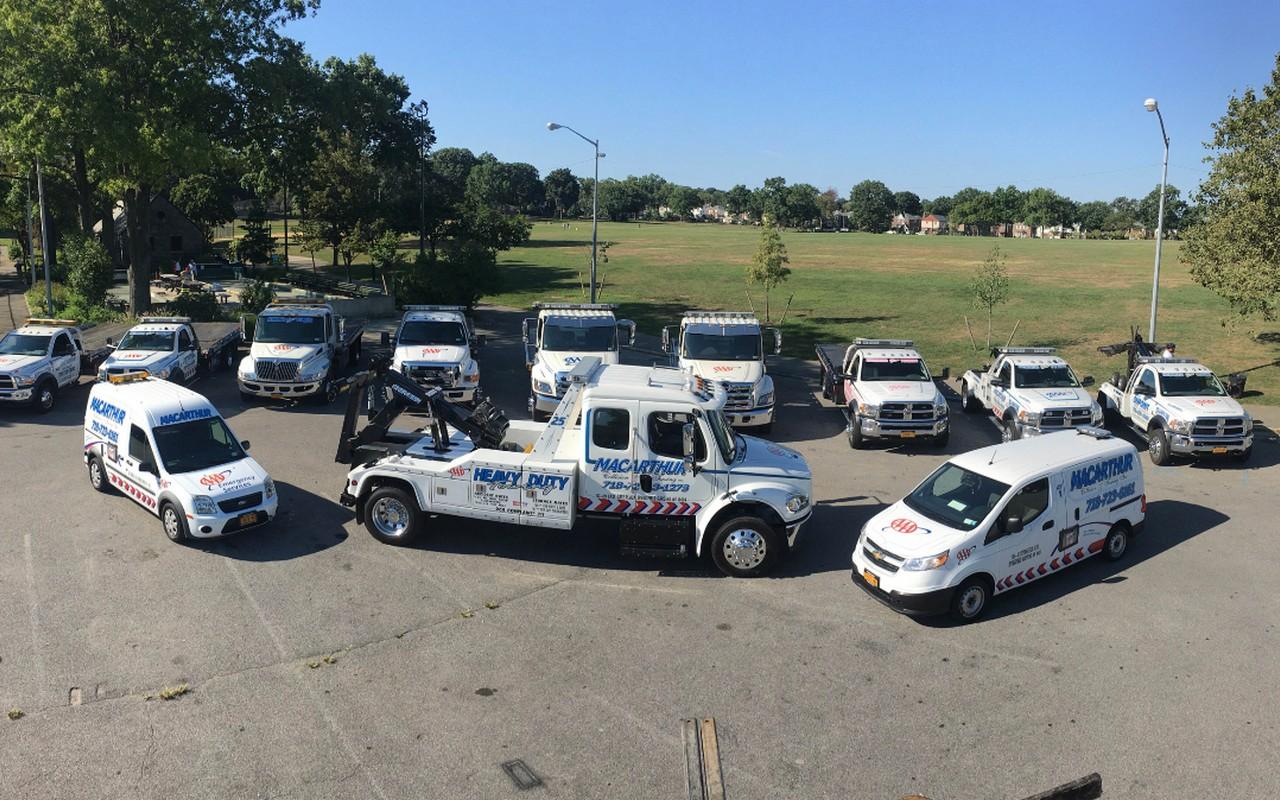
Macarthur's flatbeds leave from 170 East Lincoln Avenue in Valley Stream and pick up or deliver in every town in Nassau County, the Queens neighborhoods along the county line, and the Suffolk towns just across it, then go wherever the other address is. Every town has its own long distance towing page.
A long distance trip starts or ends in one of our towns. On the south shore and the Queens line that is Valley Stream, Lynbrook, Elmont, Franklin Square, Hempstead, Rockville Centre, Oceanside, Baldwin, Freeport, Long Beach, Cedarhurst, Lawrence, Hewlett, and in Queens, Laurelton, Rosedale, Springfield Gardens, St. Albans, Queens Village, Jamaica, and Far Rockaway.
In central and eastern Nassau, Garden City, Mineola, New Hyde Park, Westbury, East Meadow, Levittown, Hicksville, Plainview, Bethpage, Farmingdale, Merrick, Bellmore, Wantagh, Seaford, and Massapequa, and on the north shore, Great Neck, Manhasset, Port Washington, Roslyn, Glen Cove, Syosset, Jericho, and Oyster Bay, plus the Suffolk border towns of Amityville, Melville, Dix Hills, and Huntington. The full list is on the locations page.
Find your town, then send the other address.
More Towing Services From the Same Fleet
Towing
24/7 towing for cars, trucks, and everything in between.
Light Duty Towing
Cars, SUVs, vans, and pickups on flatbeds and wheel-lifts.
Heavy Duty Towing
Trucks, buses, semis, and tractor trailers, safely and securely.
Flatbed Towing
All four wheels off the ground for AWD, EV, and low vehicles.
Motorcycle Towing
Special care for your two-wheeled pride and joy.
Accident Recovery
Ready for any vehicle emergency, including off-road recovery.
One number covers every truck in the fleet.
Questions Drivers Ask About Long Distance Towing
- How far will you tow a car?
- Anywhere on Long Island, into the five boroughs, upstate, into New Jersey, Connecticut, and Pennsylvania, and farther by arrangement. The office tells you honestly what we can schedule.
- How is long distance towing priced?
- By the trip: mileage between the two exact addresses, the vehicle and whether it rolls, what is at each end, and the day. Quoted before anything is scheduled.
- Is it immediate like a local tow?
- No. A long trip commits a truck and a driver for most of a day, so it is scheduled. The office gives you a pickup window and an estimated delivery day.
- Does the car change trucks or sit in a terminal?
- No. One driver, one flatbed, from pickup to drop-off. The car is strapped at four wheels the whole way.
- Can you pick up a car I bought at auction?
- Yes. Send the lot number, your buyer number, and the release form. The driver presents it at the gate, photographs the car, checks the VIN, and loads it inside the auction's pickup window.
- Can you pick up from a private seller?
- Yes. Give us the seller's contact and address and what is changing hands. The driver can carry sealed paperwork and receive a signed title, but does not negotiate or inspect beyond condition photographs.
- What if the car does not run or roll?
- It is winched onto the deck, on skates if the wheels are locked. Say so when you call so the time at both ends is in the quote.
- Will you deliver to my driveway?
- Yes, if a flatbed can extend its deck there and the car can roll off. Otherwise the driver unloads at the curb and places the car as close as the space allows.
- What if nobody is home at delivery?
- Tell us where the keys should go and whether the car can be left unlocked in the driveway or must be locked with the keys left with a neighbor or a shop.
- Do you move classic and show cars?
- Yes. Soft straps over the tires, no hooks on the body or frame, winch only, long ramps for low cars, and photographs of every side at both ends. The deck is open, so the car will see weather.
- Do you move trucks and equipment over distance?
- Yes. Vans and light trucks ride the flatbed; box trucks and buses go on the heavy wrecker; skid steers and lifts ride the flatbed on chains. Each is quoted by the trip.
- What will the car look like when it arrives?
- The same as the pickup photographs, plus road grit and, in winter, salt, because the deck is open. Many owners wash the car when it gets home.
- Can you tow a student's car home from college?
- Yes. The student meets the truck with the keys or leaves them with campus security, and the car comes home to the mechanic you choose.
- Do dealers get an account for these moves?
- Yes. A standing account makes each inventory move or trade-in pickup one phone call. Ask for fleet service at 516-362-5350.
Did not see your question? The person who answers can.
Call Macarthur to Move a Vehicle Over Distance
One driver, one flatbed, both addresses quoted up front. Tell us where it is and where it is going.
Call 516-362-5350