Light Duty Towing
Light Duty Towing for Cars, SUVs, and Pickups That Won't Make It on Their Own
Light duty towing is most of what Macarthur does: sedans, crossovers, minivans, and half-ton pickups that will not start, will not shift, overheated, lost a wheel, or were hit. Our own flatbeds and wheel-lift wreckers run from Valley Stream 24 hours a day. Call 516-362-5350 with the year, make, and model, and the right truck comes.
Reviews and credentials
What Drivers Say About Macarthur's Light Duty Drivers
Light duty is the everyday tow, and the Google reviews are about the everyday things done right: a driver who showed up when he said, loaded the car without a scratch, and treated the owner like a person instead of a ticket. Those reviews are below.
I got locked out my car on a cold snowy night and Alex came and unlock my car. He was very quick and professional. I would definitely use this towing company again.
Great timing and professionalism. The tow truck driver Carlos was experienced and helpful. I would recommend this company and Carlos to anyone.
Not the usual experience with a towing company. Everyone that I spoke to was polite and respectful and they towed my car with care. Hopefully I never need my car towed again, but if I do, this is who I will be using!
- 1,800+Google reviews, 5.0 average as of Oct 2026
- 24/7Our own trucks, our own drivers
- 16Certifications on the shop wall
- I-CARGold Class training recognition
- 1 ShopTow fleet and body shop, Valley Stream
- LicensedDMV # 7110205 · DCA # 1389419
Every review here came from a towing or roadside call. If a Macarthur driver has towed your car, a few words on Google tell the next driver with a dead sedan who to call.
The driver who towed them is the driver who comes.
- Light Duty Towing
- Car Towing
- Tow Truck
- SUV Towing
- Pickup Towing
- Flatbed
- Wheel-Lift
- 24 Hour Towing
- Local Towing
- Breakdown Towing
- Minivan Towing
- Towing
What Light Duty Means in Towing, and Which Vehicles Fall Under It
Light duty towing covers passenger vehicles and light trucks: sedans, coupes, hatchbacks, crossovers, SUVs, minivans, and pickups up to roughly three-quarter-ton class. These ride on a flatbed or a wheel-lift wrecker. Anything heavier, a box truck, a bus, a dually hauling a trailer, is medium or heavy duty and gets a bigger truck.
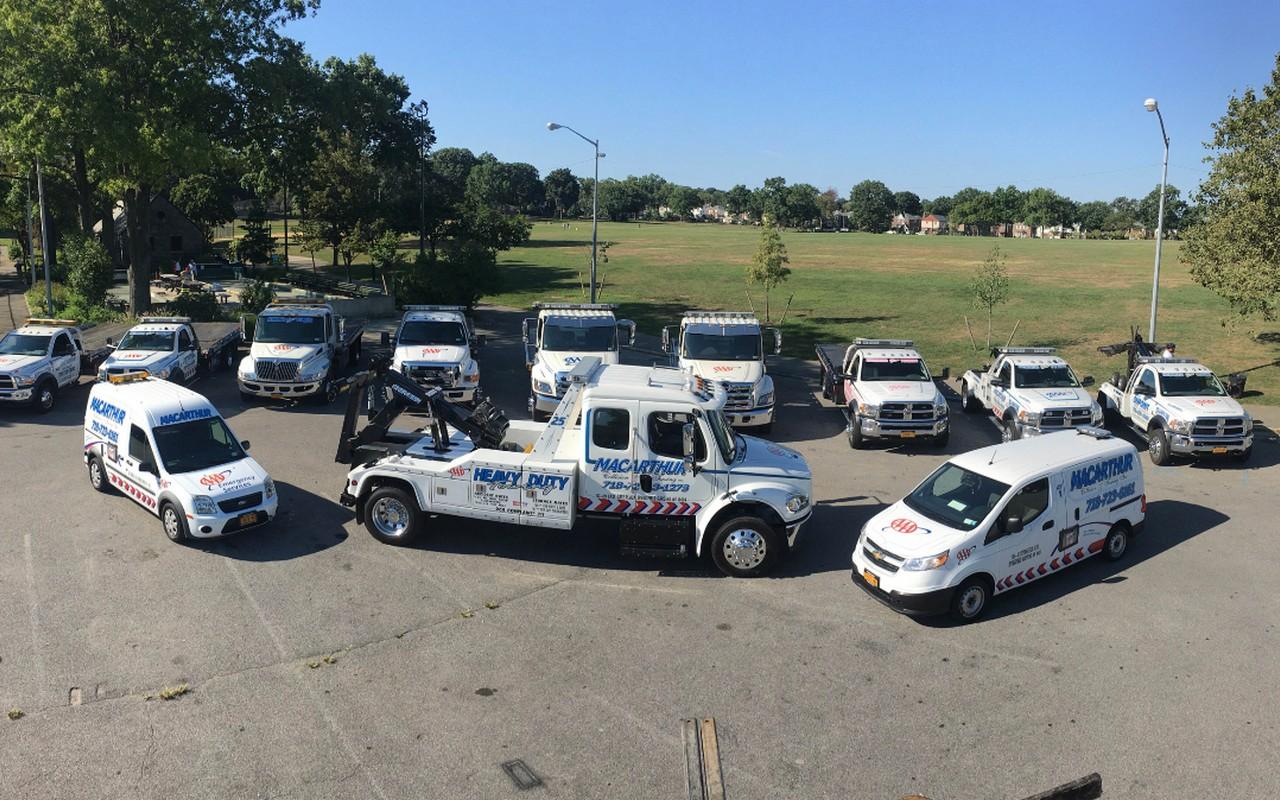
The term comes from the truck, not the car. A light duty wrecker is built to carry or lift vehicles in the weight range of ordinary passenger cars and light trucks. Macarthur's light duty fleet is a mix of flatbeds, which carry the whole vehicle on a deck, and wheel-lift wreckers, which raise one axle and tow with the other rolling. Between them they cover nearly everything parked in a Long Island driveway.
Where light duty ends is where the weight and the length stop fitting the equipment. A one-ton work truck with a utility body, a cutaway van with a box, a pickup pulling a loaded trailer: those are borderline, and the office decides from what you tell us about the vehicle. A box truck, a bus, or anything with air brakes is heavy duty and gets a wrecker built for it. If you are not sure which side of the line your vehicle is on, say what it is and we will say which truck.
Below: how we choose flatbed or wheel-lift, how each load is done, the breakdowns we see most, where the car can go, what affects the quote, and the towns the light duty trucks cover.
Not sure if it is light duty? Tell us what it is and we will tell you.
Flatbed or Wheel-Lift: How the Office Picks the Truck From What You Say on the Phone
From the year, make, and model the office knows whether the car is front-wheel-drive, all-wheel-drive, electric, or hybrid, roughly how much it weighs, and whether it sits low. All-wheel-drive, electric, hybrid, lowered, and damaged vehicles get the flatbed. A front-wheel-drive car going a short distance with nothing wrong but a no-start can go on the wheel-lift, which is quicker in tight spaces.
The two trucks do different jobs, and the choice is about protecting the car, not about which truck is parked closer.
Flatbed
The whole car rides on the deck with all four wheels off the road, strapped at each tire. Required for all-wheel-drive and four-wheel-drive, where towing on two wheels can damage the transfer case; for electric and hybrid vehicles, whose motors turn with the wheels; for lowered cars, which a wheel-lift cannot get under; and for any car with a damaged wheel, axle, or transmission. The flatbed towing page goes into each.
Wheel-lift
A yoke slides under the front or rear tires, lifts that axle, and tows with the other axle rolling. For a front-wheel-drive car with a dead battery or starter, going a few miles to a mechanic, it is quick and safe, and it fits in apartment lots and narrow driveways where a flatbed cannot extend its deck. A rear-wheel-drive car with a dead transmission may need the driveshaft pulled before a wheel-lift tow; the flatbed avoids that.
Your preference counts
If you want the flatbed for a car that does not strictly need one, because the car is new, leased, or you have had a bad tow before, say so. If one is available, you get it. The towing page explains the choice in more detail.
Year, make, and model tells us the truck. A preference tells us the rest.
How a Light Duty Tow Is Done, From the Walk-Around to the Drop-Off
The driver confirms your name and destination, walks around the car and notes any existing damage, positions the truck, and loads the car: winched up a tilted deck and strapped at four wheels on a flatbed, or lifted by one axle on a wheel-lift with straps over the tires. He checks the straps, raises the deck or the lift, and checks again before pulling away.
Here is the job as you will see it from the sidewalk.
Walk-around. Before anything is hooked, the driver looks at the car and notes dents, scrapes, and anything loose. That protects you and him. Take your own photos if you like.
Positioning. In a straight line with the car if the space allows. On a road, the truck is parked to shield the car from traffic with its lights on. In a tight lot the driver may ask to move a neighboring car or may winch from an angle.
Loading on a flatbed. Deck tilted and extended to the ground, winch cable to a proper tow point, parking brake off, neutral if the car will shift. The car is winched up slowly with the wheels straight. A car that will not shift or roll goes up on skates. Four straps, one per tire, ratcheted to the deck rails.
Loading on a wheel-lift. The yoke goes under the tires of the lifted axle, the driver secures the tires with straps, and raises the axle to towing height. The steering is locked straight or the steering wheel is secured so the rolling wheels track.
Checks and departure. Straps rechecked with the deck level or the lift raised, keys secured, lights on. Ask about riding along; it depends on the truck and the situation.
Drop-off. Reverse of the above, and the car is placed where the destination wants it, with the keys handled the way you and they agreed.
Have your keys and the tow hook from your trunk kit ready, and the load goes faster.
The Light Duty Breakdowns We See Every Week, and What Each One Needs
Dead batteries, bad starters, overheated engines, failed transmissions, flats with no spare, and cars that lost a wheel bearing or a CV axle make up most light duty calls. Some are fixed on the spot, some are a wheel-lift to a mechanic, and some are flatbed only. The symptom you describe on the phone decides which.
Every one of these starts with the same call, and most of them end with the car at the mechanic you chose.
Will not start
Usually the battery. The truck jumps it and tests it; if it will not hold a charge, we install a new one where the car sits. A clicking starter with a good battery, or an engine that turns but never catches, is a tow to the shop.
Overheated
Shut it off and do not open the radiator cap. Tell us it overheated so the driver winches it rather than starting it to move it. A mile on an overheated engine can cost a cylinder head.
Transmission or drivetrain
Revs but does not move, grinds in gear, or a CV axle is clicking and then gone. Flatbed, with the drive wheels off the road.
Flat with no spare, or a bent wheel
Many newer cars carry no spare. If you have one, the truck puts it on. If not, or the wheel is bent, the car rides the flatbed to the tire shop you name.
Wheel bearing, ball joint, or suspension
A wheel that wobbles, leans, or has separated from the car is flatbed only. The driver may need skates or a dolly under that corner to winch it aboard.
Describe the symptom and the office will say whether it is a jump, a lift, or a flatbed.
Where a Light Duty Tow Can Go, and What to Decide Before the Truck Arrives
Your mechanic, a dealership, a tire shop, your driveway, an auction, a buyer, or our collision shop in Valley Stream. The destination is your choice, and the only decision to make before the truck arrives is what should happen if the destination is closed: leave the car in their lot, or hold it at our yard until they open.
Give the office the destination's name and address and whether anyone needs to meet the truck. For a shop that will be closed, say where the keys should go. For a driveway, say where in the driveway; a flatbed needs room to tilt its deck and a clear path for the car to roll off. For a car with body damage, the shortest path is our collision shop at 170 East Lincoln Avenue, where the estimate and the insurance claim are handled under the same roof. The destinations section on the towing page covers each option, including collecting a car from another yard once it is released to you.
Tell us the address and whether they will be open. That is all we need.
What Affects the Quote for a Light Duty Tow, and How to Get It Right the First Time
Distance from pickup to drop-off, the vehicle and whether it needs the flatbed, any winching or recovery before the tow, and the time of day. Macarthur quotes the tow on the phone from those four things before the truck leaves, and the quote is the price if the job matches what you described.
Light duty is the most predictable tow we do, so the quote is usually simple. Both addresses give the distance. Year, make, and model gives the truck. How the car is sitting gives any recovery work: a car in a ditch, on a lawn, in a snowbank, or with a wheel that will not turn adds a winch or skates to the job. Night and holiday calls are priced as such and the office says so.
If the driver arrives and finds a different job, a car described as on the street that is in a garage with low clearance, or a car described as on the shoulder that is down an embankment, he tells you the new number before he touches it and you decide. The cost section on the towing page walks through each factor, and the flatbed page explains when the flatbed costs a little more than the wheel-lift for the same short tow.
Both addresses and the vehicle get you the number before the truck rolls.
Light Duty Cases That Need a Word on the Phone: Garages, Tight Driveways, EVs, and Leases
A few light duty situations change which truck is sent or how the driver sets up: a car in a parking garage with low clearance, a narrow driveway or apartment lot, an electric or hybrid vehicle with a dead 12-volt battery, a lowered car, or a lease or new car where the owner wants no lift marks. Mention any of these when you call.
Parking garages. A flatbed is tall. Tell us the posted clearance and whether the car can be rolled to the exit. We may send a wheel-lift or meet the car at the ramp.
Tight driveways and lots. A flatbed needs room behind the truck to extend its deck. In a narrow space the wheel-lift is often the only truck that fits, and for an all-wheel-drive car the driver may winch it to a wider spot first.
Electric and hybrid. Flatbed only, and if the 12-volt battery is dead the car may not shift or unlock. The driver carries a jump pack for the manufacturer's jump point and skates for the drive wheels. The flatbed page covers this.
Lowered cars. Long ramps and boards to flatten the approach angle. Say the car is lowered so the equipment is on the truck.
Leases and new cars. Ask for the flatbed. Lease inspectors look for lift marks, and most manufacturers specify flatbed towing in the owner's manual.
Garage, tight lot, EV, or lease? One sentence on the phone sets up the right truck.
Light Duty Towing Across Nassau County and the Queens Line, From the Yard in Valley Stream
Macarthur's light duty trucks leave from 170 East Lincoln Avenue in Valley Stream and cover every town in Nassau County, the Queens neighborhoods along the county line, and the Suffolk towns just across it, 24 hours a day. Every town has its own light duty towing page.
The yard is on the Nassau–Queens line, so the south shore and southeastern Queens are closest: Valley Stream, Lynbrook, Elmont, Franklin Square, West Hempstead, Hempstead, Malverne, Rockville Centre, Oceanside, Baldwin, Freeport, Long Beach, East Rockaway, and the Five Towns of Cedarhurst, Lawrence, Woodmere, and Hewlett, and in Queens, Laurelton, Rosedale, Springfield Gardens, Cambria Heights, St. Albans, Jamaica, and Far Rockaway.
The same trucks cover central and eastern Nassau, Garden City, Mineola, New Hyde Park, Westbury, Uniondale, East Meadow, Levittown, Hicksville, Plainview, Merrick, Bellmore, Wantagh, Seaford, and Massapequa, the north shore from Great Neck and Manhasset to Glen Cove and Syosset, and the Suffolk border towns of Amityville, Melville, and Huntington. The full list is on the locations page. If your town is not there, call anyway.
Find your town and its light duty towing page.
More Towing Services From the Same Fleet
Towing
24/7 towing for cars, trucks, and everything in between.
Heavy Duty Towing
Trucks, buses, semis, and tractor trailers, safely and securely.
Flatbed Towing
All four wheels off the ground for AWD, EV, and low vehicles.
Motorcycle Towing
Special care for your two-wheeled pride and joy.
Long Distance Towing
Convenient and economical long distance towing for any vehicle.
Accident Recovery
Ready for any vehicle emergency, including off-road recovery.
One number covers every truck in the fleet.
Questions Drivers Ask About Light Duty Towing
- What counts as light duty towing?
- Passenger cars, crossovers, SUVs, minivans, and pickups up to roughly three-quarter-ton class. Box trucks, buses, and anything with air brakes are heavy duty and get a bigger wrecker.
- Do you tow 24 hours a day?
- Yes. Light duty towing runs 24 hours a day, 7 days a week, including holidays. Call 516-362-5350.
- Will my car go on a flatbed or a wheel-lift?
- All-wheel-drive, electric, hybrid, lowered, and damaged vehicles go on the flatbed. A front-wheel-drive car with a no-start going a short distance can go on the wheel-lift. Tell us the year, make, and model and we choose, or ask for the flatbed and you get it if one is available.
- Can you tow a car that will not start or shift?
- Yes. A car that will not shift is winched onto the flatbed on skates. A no-start is usually jumped first; if the battery is dead for good, we can install a new one on the spot or tow the car to your mechanic.
- Can you tow my car to my own mechanic?
- Yes. Any destination you choose: your mechanic, a dealership, a tire shop, your driveway, or our collision shop in Valley Stream. You are never required to use our body shop.
- What if my mechanic is closed when the truck gets there?
- We leave the car in their lot with the keys handled the way they ask, or hold it at our yard and bring it over when they open. Say which when you call.
- My car is in a parking garage. Can you get it out?
- Usually. Tell us the posted clearance. A flatbed does not fit in every garage, so we may send a wheel-lift or meet the car at the ramp.
- Can you tow out of a narrow driveway or apartment lot?
- Yes. The wheel-lift fits where a flatbed cannot extend its deck. For an all-wheel-drive car in a tight spot the driver may winch it to a wider space before loading it on the flatbed.
- Do you tow electric and hybrid cars?
- Yes, always on a flatbed. If the 12-volt battery is dead the driver uses the manufacturer's jump point or wheel skates to load the car.
- Will a wheel-lift damage my car?
- Not when used on the right car. It is for front-wheel-drive vehicles going a short distance. We do not use it on all-wheel-drive, electric, lowered, or damaged vehicles.
- I have a flat and no spare. Can you help?
- Yes. The car rides the flatbed to the tire shop you choose. If you do have a usable spare, the driver puts it on and you drive there yourself.
- Can you tow my car if it overheated?
- Yes. Tell us it overheated so the driver winches it rather than starting it to move it onto the deck.
- Will you quote the price before the truck comes?
- Yes. From your location, vehicle, and destination, on the phone, before the truck leaves. If the job matches what you described, the quote is the price.
- Can I ride along?
- Often, yes. It depends on the truck, how many people are with you, and the situation. Ask the driver.
- Is Macarthur licensed?
- Yes. Macarthur Auto Body and Towing operates under New York State DMV number 7110205 and New York City Department of Consumer Affairs license number 1389419.
Did not see your question? The person who answers can.
Call Macarthur for a Light Duty Tow Anywhere in Nassau County
Flatbeds and wheel-lifts, our own drivers, 24 hours a day. Tell us the make and model and where it is going.
Call 516-362-5350