Flatbed Towing
Flatbed Towing for the Cars That Should Never Be Dragged: AWD, Electric, Lowered, and Damaged
A flatbed carries your vehicle on a deck with all four wheels off the road, which is the only correct tow for all-wheel-drive, electric, hybrid, lowered, and damaged cars. Macarthur runs its own flatbeds out of Valley Stream 24 hours a day. Call 516-362-5350, tell us the year, make, and model, and the flatbed comes.
Reviews and credentials
What Drivers Say About Macarthur's Flatbed Drivers
The flatbed is the truck most drivers see when Macarthur comes for a car that cannot be dragged, and the reviews on Google are mostly about the driver who ran it: careful with the car, clear about what he was doing, and gone with the car strapped at all four wheels. Those reviews are below.
I got locked out my car on a cold snowy night and Alex came and unlock my car. He was very quick and professional. I would definitely use this towing company again.
Great timing and professionalism. The tow truck driver Carlos was experienced and helpful. I would recommend this company and Carlos to anyone.
Not the usual experience with a towing company. Everyone that I spoke to was polite and respectful and they towed my car with care. Hopefully I never need my car towed again, but if I do, this is who I will be using!
- 1,800+Google reviews, 5.0 average as of Oct 2026
- 24/7Our own trucks, our own drivers
- 16Certifications on the shop wall
- I-CARGold Class training recognition
- 1 ShopTow fleet and body shop, Valley Stream
- LicensedDMV # 7110205 · DCA # 1389419
Every review here came from a towing or roadside call. If a Macarthur flatbed has carried your car, a few words on Google tell the next AWD or EV owner on the shoulder who to call.
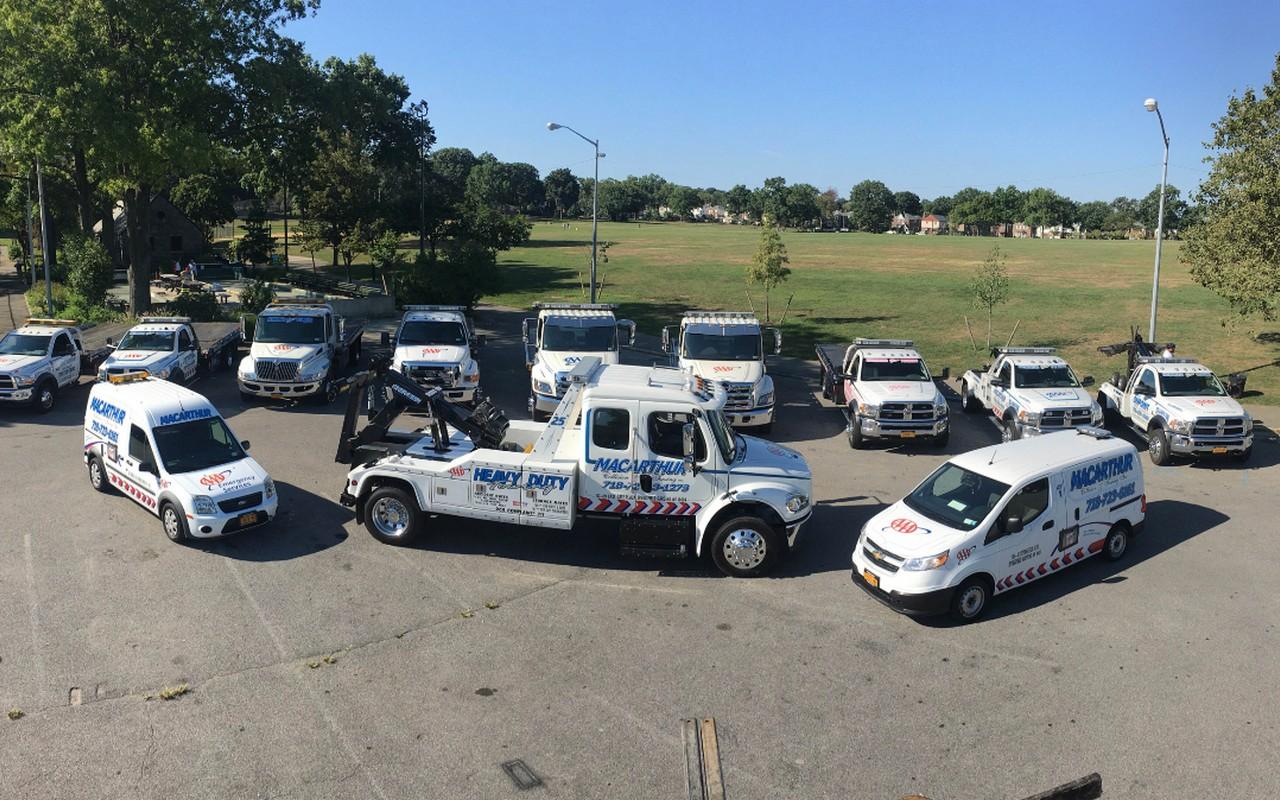
The truck in the photos is the truck that comes.
- Towing
- Tow Truck
- Flatbed
- Flatbed Towing
- Rollback
- Flatbed Tow Truck
- AWD Towing
- EV Towing
- Tesla Towing
- Car Towing
- 24 Hour Towing
- Roadside Assistance
What a Flatbed Tow Truck Does Differently, and Why It Is the Right Tow for Most Cars on the Road Today
A flatbed, also called a rollback, has a steel deck that tilts and slides to the ground. The vehicle is winched or driven onto the deck, strapped at each wheel, and carried with nothing touching the road. Because no wheel turns during the tow, nothing in the drivetrain does any work, which is why a flatbed is the safe choice for all-wheel-drive, electric, hybrid, and damaged vehicles.
The older style of tow truck, the wheel-lift, picks up one end of the car and tows it with the other end rolling. For a plain front-wheel-drive car going a few miles, that is fine. But a growing share of what is parked on Long Island driveways is all-wheel-drive, electric, or hybrid, or sits low enough that a lift would hit the bumper. For those, the only tow that does no harm is the one where the whole car rides. That is the flatbed, and it is most of Macarthur's light duty fleet.
A flatbed also has a long winch cable and a tilting deck, which means a car with a seized engine, locked wheels, a broken axle, or a crushed front end can be pulled aboard without being pushed, started, or steered. And because the deck is flat, the car is strapped at the wheels, not hooked at the frame or bumper, so nothing on the car's body takes the load. The sections below cover which vehicles must ride this way, how a load is done, the electric vehicle details, low cars, and how the flatbed is priced against the wheel-lift.
Not sure if your car needs a flatbed? Tell us the make and model and we will say.
Vehicles That Must Ride on a Flatbed: All-Wheel Drive, Electric, Hybrid, Lowered, Damaged, and Collector Cars
All-wheel-drive and four-wheel-drive vehicles, electric and hybrid vehicles, lowered cars, cars with a damaged wheel, axle, or transmission, and classic or collector cars should only be towed on a flatbed. For each, towing on two wheels risks damage that costs far more than the tow.
Here is why each of these needs the deck, so you can tell the person who answers the phone what you are driving and why it matters.
All-wheel drive and four-wheel drive
Subaru, Audi quattro, BMW xDrive, Mercedes 4MATIC, most SUVs and crossovers, many pickups, and a growing number of sedans. The wheels are connected through a center differential or transfer case, and towing with one axle rolling spins that unit without lubrication or with the engine off. The owner's manual for nearly every one says flatbed only, and a dealer will ask how the car was towed if the transfer case fails later.
Electric and hybrid vehicles
An EV's drive motors are mechanically connected to the wheels whether the car is on or off. Rolling the drive wheels generates current and heat the system is not expecting. Tesla, Ford, Hyundai, Kia, Nissan, Chevrolet, and every other EV maker calls for a flatbed. The electric vehicle section below has the specifics, including what happens when the 12-volt battery is dead and the car will not shift.
Lowered cars, sports cars, and anything with a low front splitter
A wheel-lift has to get its yoke under the front bumper, and on a low car it cannot without contact. A flatbed with long ramps and boards under them flattens the approach angle so the nose clears. The lowered car section explains the setup.
Damaged wheel, axle, suspension, or transmission
If a wheel is not pointing the right way, a tire is shredded to the rim, or the car makes a grinding noise in gear, it cannot roll safely at any speed. The flatbed's winch brings it aboard without rolling it more than a few feet, and the driver checks underneath for fluid leaks before loading.
Classic, collector, and freshly restored cars
Nothing hooks to a bumper, a leaf spring, or a control arm. Soft straps go over the tires, the winch does the work if the car does not run, and the driver asks before touching anything original. The special vehicles section on the towing page has more.
New cars, leases, and cars under warranty
Many manufacturers specify flatbed towing in the warranty booklet, and a lease return inspector looks for the marks a wheel-lift leaves. If the car is new, leased, or still under warranty, ask for the flatbed; it is the tow the manufacturer wants.
AWD, EV, lowered, or damaged? Say so when you call and the flatbed is sent.
How a Car Is Loaded on a Macarthur Flatbed, Step by Step
The driver positions the truck in line with the car, tilts and extends the deck to the ground, attaches the winch to a proper tow point, winches the car up the deck with the wheels straight, and straps it at all four wheels. He checks the straps, raises the deck, checks again, and goes. The whole process is done without pushing, towing, or starting the car.
Here is what you will see when the flatbed arrives, so nothing about it is a surprise.
Positioning
The truck lines up with the car, ideally nose to nose or nose to tail in a straight line, with room behind the truck for the deck to extend. In a tight driveway or a parking garage, the driver may ask to move a car or may winch from an angle with the car's wheels turned. If the car is on a road, the truck is parked to shield the car from traffic with its lights on.
The deck and the winch
The deck tilts and slides until its rear edge is on the ground. The driver finds the car's tow point, a threaded hook in the bumper on most newer cars, a frame hook or subframe point on older ones, and connects the winch cable or a strap. He releases the parking brake, puts the car in neutral if it will shift, and winches it up the deck slowly, keeping the wheels straight. A car that will not shift is winched with the drive wheels on skates or dollies so nothing drags.
Strapping at four corners
Once the car is on the deck, a strap goes over each tire and is ratcheted to the deck's tie-down rails. Four-point wheel strapping holds the car by its tires, so the suspension works normally during the tow and nothing pulls on the body, the frame, or the bumpers. The driver checks each strap for tension and for contact with brake lines or trim.
Before leaving
Deck up and locked, straps rechecked after the deck is level, keys secured, lights and markers on. If you want a photo for your records, take it now. Whether you ride along depends on the truck and the situation; ask the driver.
At the drop-off
The process runs in reverse, and the driver places the car where the destination wants it. A car coming to our collision shop after an accident is unloaded in our lot and checked in; a car going to your mechanic is left where they say, with the keys handled the way they prefer.
Have the tow hook from your trunk kit handy and the load goes faster.
Flatbed Towing for Electric Vehicles: Tow Mode, Dead 12-Volt Batteries, and Delivering to a Charger
Every electric vehicle Macarthur tows rides on a flatbed. Before loading, the driver puts the car in its tow mode if it has one, releases the parking brake, and winches it aboard. If the 12-volt battery is dead and the car will not shift or unlock, he uses the manufacturer's jump point or skates under the drive wheels. A depleted EV can be delivered to a public charger or to your home outlet.
EVs are a growing share of our flatbed calls, and most of the calls are the same two problems: the main battery ran down, or the small 12-volt battery that runs the electronics died and the car will not wake up.
Tow mode. Tesla and several other brands have a setting that releases the parking brake and lets the car roll freely for loading. The driver knows where it is on common models; if the screen is dead, see the next point. The car is never put in a mode that lets it drive itself onto the deck.
Dead 12-volt battery. When the small battery dies, the car cannot shift to neutral, release the brake, or sometimes even open the doors or charge port. Most EVs have a jump point under the hood or behind a cover for exactly this, and the driver carries a jump pack to wake the car long enough to put it in tow mode. If that is not possible, wheel skates go under the drive wheels and the car is winched aboard on them.
Depleted main battery. There is no gas can for an EV. The flatbed delivers the car to the nearest working charger that fits your connector, or to your garage outlet, whichever you prefer. Tell the person who answers which it is.
Hybrids. Plug-in and conventional hybrids have the same motor-to-wheel connection and ride the same way. The EV and hybrid section on the homepage lists which brands require what.
EV will not wake up? Tell us the make and the driver brings the jump pack and the skates.
Lowered Cars, Sports Cars, and Low Splitters: Ramps, Boards, and the Approach Angle
A flatbed deck meets the ground at an angle, and a car with a low nose or a front splitter will scrape going up it unless the angle is flattened. Macarthur's drivers carry long ramps and boards to extend the slope, and winch low cars aboard slowly from a straight line. Tell us the car is lowered when you call so the right equipment is on the truck.
Approach angle is the problem. The deck tilts down to the road, and the steeper the slope the sooner a low bumper touches it. The fix is to make the slope longer: extension ramps hooked to the deck's rear edge, and wood blocks under the ramps so the first step up is shallow. For a very low car, the driver may park the truck's rear wheels in a dip or the car's front wheels on a rise to flatten the geometry further.
The winch does the moving, not the engine, so the driver can stop at any point if something is close to contact and add a board. Once on the deck, the straps go on the tires as usual; a lowered car is never hooked by its lowered suspension. Aftermarket front lips, side skirts, and air dams are the parts most often damaged by a careless tow, and they are the parts the driver is watching. If the car has air suspension, raise it to its highest setting before the truck arrives if the car will still power up. The special vehicles section on the towing page covers classics and sports cars in more detail.
Lowered or on air? Raise it if you can, and tell us so the ramps come.
Flatbed Versus Wheel-Lift: When We Send Each and How to Ask for the Flatbed
Macarthur sends a flatbed whenever the vehicle is all-wheel-drive, electric, hybrid, lowered, damaged, or valuable, and whenever you ask for one. A wheel-lift is sent for a front-wheel-drive car that will not start and is going a short distance, because it is quicker in tight spaces. If you have a preference, say so on the phone and you get the flatbed if it is available.
The wheel-lift is not a lesser truck; it is a different tool. It fits where a flatbed cannot, loads faster, and is the right call for a short local move of a front-wheel-drive car with nothing wrong but a dead battery or a bad starter. The towing page explains how the dispatcher chooses between them from what you say about the car.
Where the flatbed wins is anything that should not roll: the drivetrains and damage listed above, plus any car the owner simply wants carried rather than towed. Some people ask for the flatbed because the car is new, because they have had a bad wheel-lift tow before, or because they are watching. All of those are fine reasons. The flatbed is a few minutes slower to load and can cost a little more for the same short tow; the cost section below explains that honestly. What it never costs is the transfer case, the EV motor, or the front bumper.
Want the flatbed regardless? Just say so when you call.
Beyond Breakdowns: Dealer Deliveries, Auction Pickups, Project Cars, and Long Distance Flatbed Moves
The flatbed is also the truck for moving a car that runs fine but should not be driven: a dealer delivery, an auction or private-sale pickup, a project car without plates or brakes, a collector car going to a specialist, or a long distance move across Long Island, into the city, or out of state. Macarthur quotes these by the pickup and drop-off addresses and the vehicle.
Not every flatbed job starts with a breakdown. A lot of them are planned moves where the car has no plates, no insurance yet, no brakes, or simply too much value to put miles on. The flatbed picks it up at a dealership, an auction lane, a seller's driveway, or a storage unit, and delivers it to your garage, your shop, or a buyer. For a non-running car from a private seller, the driver photographs it before loading and confirms the VIN against the title you send us.
Long distance moves are scheduled rather than immediate and priced by mileage and vehicle type; the long distance towing page covers how those are set up. Dealers and repair shops use the same flatbed to shuttle inventory and customer cars between lots, and the commercial accounts section on the towing page explains how that is arranged. For equipment rather than cars, skid steers and lifts ride the same deck under equipment hauling.
Buying a car that cannot be driven home? Send both addresses and we quote the move.
What a Flatbed Tow Costs Compared to a Wheel-Lift, and How Macarthur Quotes It
A flatbed tow is priced on the distance from pickup to drop-off, the vehicle, whether winching or skates are needed, and the time of day. For the same short tow it can cost a little more than a wheel-lift because loading takes longer. Macarthur quotes the number on the phone from your location, vehicle, and destination before the truck leaves.
The honest comparison is this: the flatbed takes a few more minutes to load and is a bigger truck to run, so for a short tow of a car that could go either way, the wheel-lift is sometimes the cheaper line on the quote. For every vehicle listed in the who needs it section, there is no comparison, because the wheel-lift is not an option.
What moves the number is distance first, then the vehicle, then recovery work: winching a car out of a ditch or off a lawn before it can be loaded, skates under locked wheels, or a long-ramp setup for a low car. Night and holiday calls are priced as such. Give the person who answers both addresses, the year, make, and model, and how the car is sitting, and the quote reflects the real job. If the driver arrives and the job is different from what was described, he tells you the new number before he touches the car. The towing cost section on the towing page goes through each factor.
Both addresses and the vehicle get you a quote before the truck rolls.
Flatbed Towing Across Nassau County and the Queens Line, From the Yard in Valley Stream
Macarthur's flatbeds leave from 170 East Lincoln Avenue in Valley Stream and cover every town in Nassau County, the Queens neighborhoods along the county line, and the Suffolk towns just across it, 24 hours a day. Every town has its own flatbed towing page.
From the yard on the Nassau–Queens line, the flatbeds are closest to the south shore and southeastern Queens: Valley Stream, Lynbrook, Elmont, Franklin Square, Hempstead, Rockville Centre, Oceanside, Freeport, Long Beach, and the Five Towns around Cedarhurst, and across the line in Laurelton, Rosedale, Springfield Gardens, Jamaica, and Far Rockaway.
The same trucks cover central and eastern Nassau, Garden City, Mineola, Westbury, East Meadow, Levittown, Hicksville, Plainview, Bethpage, Wantagh, and Massapequa, the north shore from Great Neck and Manhasset to Glen Cove and Syosset, and the Suffolk border towns of Amityville, Melville, and Huntington. Every town on the locations page has a flatbed page. If yours is not listed, call anyway.
Find your town and the flatbed page for it.
More Towing Services From the Same Fleet
Towing
24/7 towing for cars, trucks, and everything in between.
Light Duty Towing
Cars, SUVs, vans, and pickups on flatbeds and wheel-lifts.
Heavy Duty Towing
Trucks, buses, semis, and tractor trailers, safely and securely.
Motorcycle Towing
Special care for your two-wheeled pride and joy.
Long Distance Towing
Convenient and economical long distance towing for any vehicle.
Accident Recovery
Ready for any vehicle emergency, including off-road recovery.
One number covers every truck in the fleet.
Questions Drivers Ask About Flatbed Towing
- Does my car need a flatbed?
- If it is all-wheel-drive, four-wheel-drive, electric, hybrid, lowered, or has a damaged wheel, axle, or transmission, yes. Tell us the year, make, and model and we send the right truck.
- Do you tow Teslas on a flatbed?
- Yes, always. The driver puts the car in tow mode if the screen is alive, or uses the 12-volt jump point and wheel skates if it is not, and winches it aboard with all four wheels off the road.
- My EV is completely dead. Can you still load it?
- Yes. The driver wakes the 12-volt system with a jump pack to release the brake and shift to neutral. If that is not possible, skates go under the drive wheels and the car is winched up on them.
- Can you deliver my electric car to a charger?
- Yes. Tell us your connector type and whether you want a public charger or your home outlet, and the flatbed takes the car there.
- Will a flatbed scrape my lowered car?
- Not when it is loaded correctly. The driver uses extension ramps and boards to flatten the approach angle and winches the car on slowly. Tell us the car is lowered when you call so the equipment is on the truck.
- How is the car held on the deck?
- A strap over each of the four tires, ratcheted to the deck rails. The car is held by its wheels, so nothing pulls on the body, frame, or bumpers and the suspension works normally during the tow.
- Can you tow a car with locked or damaged wheels?
- Yes. Wheel skates or dollies go under the wheels that will not roll, and the winch brings the car up the deck without turning them.
- Is a flatbed more expensive than a wheel-lift?
- For the same short tow it can be a little more, because loading takes longer. For AWD, EV, lowered, or damaged vehicles the wheel-lift is not an option, so there is nothing to compare. We quote on the phone either way.
- Can I ask for a flatbed even if my car does not need one?
- Yes. Tell the person who answers you want the flatbed, and if one is available it is sent.
- Do you flatbed motorcycles?
- Yes. Bikes ride upright on the deck with the front wheel in a chock and soft straps on the frame. See the motorcycle towing page.
- Can a flatbed get into a parking garage?
- Often not; the deck and the truck are tall. Tell us the posted clearance and we send a wheel-lift if the flatbed will not fit, or meet the car at the garage exit if it can be rolled there.
- Can you pick up a car I bought at auction or from a private seller?
- Yes. Give us the pickup address, hours, and any paperwork required. The driver photographs the car before loading and delivers it to your driveway or shop.
- Where do you tow to?
- Wherever you say: our collision shop in Valley Stream, your mechanic, a dealership, a tire shop, your driveway, or a buyer. You are never required to use our body shop.
- Do you flatbed 24 hours a day?
- Yes. Towing runs around the clock, every day, including holidays. Call 516-362-5350.
Did not see your question? The person who answers can.
Call Macarthur for a Flatbed Anywhere in Nassau County
Our own flatbeds, our own drivers, 24 hours a day. Tell us the make and model and where it is going.
Call 516-362-5350