Tow Company
24-Hour Towing in Valley Stream and Across Nassau County
Macarthur Auto Body and Towing sends its own flatbeds, wheel-lift wreckers, and heavy wreckers from Valley Stream to breakdowns and accidents anywhere in Nassau County and the Queens neighborhoods on the county line, 24 hours a day. Call 516-362-5350 with your location, your vehicle, and where it needs to go.
Reviews and credentials
What Drivers Say About Macarthur's Tow Truck Drivers
The reviews drivers leave for Macarthur on Google are mostly about the person who showed up: a driver who was careful with the car, explained what he was doing, and treated a bad night like a normal job. Those reviews are below, in the customers' own words.
I got locked out my car on a cold snowy night and Alex came and unlock my car. He was very quick and professional. I would definitely use this towing company again.
Great timing and professionalism. The tow truck driver Carlos was experienced and helpful. I would recommend this company and Carlos to anyone.
Not the usual experience with a towing company. Everyone that I spoke to was polite and respectful and they towed my car with care. Hopefully I never need my car towed again, but if I do, this is who I will be using!
- 1,800+Google reviews, 5.0 average as of Oct 2026
- 24/7Our own trucks, our own drivers
- 16Certifications on the shop wall
- I-CARGold Class training recognition
- 1 ShopTow fleet and body shop, Valley Stream
- LicensedDMV # 7110205 · DCA # 1389419
Every review on this page came from a towing or roadside call, not a body shop visit. A lockout on a snowy night, a tow with a driver who answered every question, a car loaded with care. If a Macarthur driver has helped you, a few words on Google is how the next driver on the shoulder finds us.
The driver in the review is the driver who comes.
- Towing
- Tow Truck
- 24 Hour Towing
- Flatbed Towing
- Wheel-Lift Towing
- Heavy Duty Towing
- Light Duty Towing
- Accident Towing
- Breakdown Towing
- Motorcycle Towing
- Long Distance Towing
- Equipment Hauling
- Roadside Assistance
- Jump Start
- Lockout Service
- Tire Change
- Fuel Delivery
- Winching
- Commercial Towing
- Fleet Towing
Why Every Macarthur Tow Is a Macarthur Truck and a Macarthur Driver
Macarthur owns its tow trucks and employs its drivers. When you call 516-362-5350, the person who answers sends one of our own trucks from Valley Stream, not a subcontractor, so the company you spoke to is the company that shows up, hooks up, and drops off.
A lot of towing phone numbers belong to a call center that resells the job to whoever is closest and cheapest. You get a truck with somebody else's name on the door, a driver who does not answer to the company you called, and nobody to call back if the car arrives with a new scratch. Macarthur is the opposite of that. The trucks are ours, the drivers are on our payroll, and the yard they return to is at 170 East Lincoln Avenue in Valley Stream.
That changes how a tow goes. The driver knows what the shop will ask about the car. He knows that an all-wheel-drive car goes on the flatbed, that a lowered car needs the long ramps and a few boards, that a motorcycle gets soft straps and chocks. He is not learning your vehicle on the clock. And because the same company runs the collision shop, a car that was in an accident can go from the scene to a repair bay in one move, with one set of paperwork and one phone number for the insurance adjuster.
We are registered with the New York State DMV, number 7110205, and licensed by the New York City Department of Consumer Affairs, license number 1389419, and we tow 24 hours a day, 7 days a week, holidays included. Below is every towing and roadside service we offer, each with its own page. Further down this page you will find how a call works, how we choose the truck, where we tow to, what affects the price, and the towns we cover.
Every towing service, each with its own page
Towing
24/7 towing for cars, trucks, and everything in between.
Light Duty Towing
Cars, SUVs, vans, and pickups on flatbeds and wheel-lifts.
Heavy Duty Towing
Trucks, buses, semis, and tractor trailers, safely and securely.
Flatbed Towing
All four wheels off the ground for AWD, EV, and low vehicles.
Motorcycle Towing
Special care for your two-wheeled pride and joy.
Long Distance Towing
Convenient and economical long distance towing for any vehicle.
Accident Recovery
Ready for any vehicle emergency, including off-road recovery.
Equipment Hauling
We move it all, including heavy equipment.
Need a truck now? The number rings at the shop.
What Macarthur Tows, From a Compact Car to a Loaded Tractor Trailer
Macarthur tows passenger cars, SUVs, minivans, pickups, work vans, box trucks, buses, dump trucks, tractor trailers, motorcycles, scooters, and job site equipment. The right truck for each is already in the fleet, so you describe the vehicle once and we send the match.
The honest answer to "can you tow my car" is almost always yes. The useful question is which truck. Here is how the fleet breaks down by what it carries.
Cars, SUVs, minivans, and pickups
This is most of our day. A sedan that will not start in a driveway in Lynbrook, an SUV with a blown transmission on a side street in Hempstead, a pickup that lost a wheel bearing in a parking lot in Freeport. These ride on a flatbed or a wheel-lift depending on the drivetrain and the damage. Details are on the light duty towing page.
Work vans, cutaways, and small commercial trucks
Plumbers, electricians, delivery vans, and landscaper trucks with a full load in the back. These are heavier than they look, and the load has to stay put during the tow. We tow them loaded, strapped, and to the shop or yard you name, which matters when the van is also your inventory for the day.
Box trucks, buses, dump trucks, and tractor trailers
The heavy wreckers handle straight trucks, school and coach buses, dump trucks, and tractor trailers, loaded or empty. Tell us the gross weight and what is in the trailer when you call so the right wrecker leaves the yard. The heavy duty towing page covers how a heavy tow is set up and what the driver needs from you.
Motorcycles, scooters, and trikes
Bikes go on the flatbed, upright, with soft straps on the bars and frame and chocks on the wheels. Nothing gets dragged, and nothing touches the tank or the fairings. The motorcycle towing page explains the setup for sport bikes, cruisers, and touring bikes.
Skid steers, compressors, lifts, and other equipment
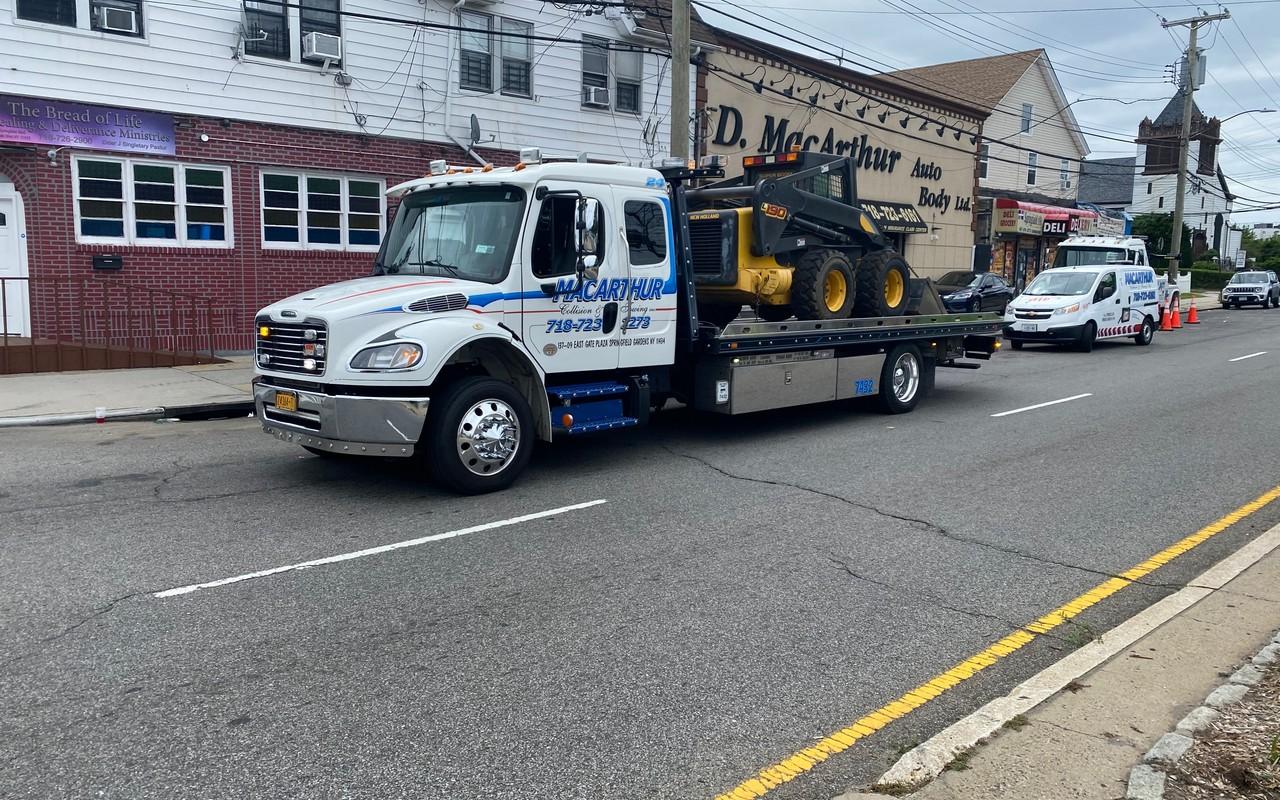
Contractors and landscapers call us to move equipment between job sites or to a repair shop. Skid steers, small excavators, compressors, forklifts, and scissor lifts ride on a flatbed with chains and binders. See equipment hauling for what we move and what we need to know about the piece.
Not sure which truck you need? Describe the vehicle and we pick it.
Flatbed, Wheel-Lift, or Heavy Wrecker: How We Choose the Truck for Your Vehicle
A flatbed carries the whole vehicle on a deck and is the right tow for all-wheel-drive, electric, hybrid, lowered, and damaged cars. A wheel-lift raises one axle and is quicker for a short local move of a front-wheel-drive car. A heavy wrecker is for trucks and buses. Macarthur picks the truck from what you tell us on the phone.
Most people never think about tow trucks until they need one, so here is the difference in plain terms and why it matters for your car.
The flatbed, and when it is the only right answer
A flatbed has a deck that tilts and slides back to the ground. The car is winched up, sits with all four wheels on the deck, and is strapped at each wheel. Nothing rolls, nothing drags, and nothing on the car does any work during the tow. That is why it is required for all-wheel-drive and four-wheel-drive vehicles, where towing on two wheels can damage the transfer case or differential. It is why nearly every electric vehicle manufacturer calls for it, since an EV's drive motors are connected to the wheels even when the car is off. And it is the only safe way to move a car with a bent wheel, a broken axle, a seized transmission, or front-end damage from a collision. The flatbed towing page goes into the EV, AWD, and low-clearance details.
The wheel-lift, and when it saves you time
A wheel-lift wrecker slides a yoke under the front or rear tires, lifts that axle, and tows with the other axle rolling on the road. For a front-wheel-drive car that simply will not start and needs to go a few miles to a mechanic, it is quick and perfectly safe, and the lift is faster in tight spots like an apartment lot or a narrow driveway. We will not use it on an all-wheel-drive car or an EV, and we will not use it when the rolling axle is damaged.
The heavy wrecker
A heavy wrecker has the boom, the underlift, and the weight to tow a loaded straight truck or a tractor trailer without the back end of the wrecker lifting off the road. It also carries the winch capacity to recover a truck that has gone off the pavement. If you run a fleet, the heavy duty towing page is written for you.
If you have a preference, say so
Some owners want a flatbed for a car that technically does not need one, because the car is new, or because they have had a bad tow before. Tell the person who answers. If the right truck for the job is available, you get it.
AWD, EV, or lowered? Ask for the flatbed when you call.
What to Tell Us When You Call for a Tow, and What the Driver Does When He Arrives
When you call 516-362-5350, tell us three things: exactly where you are, what the vehicle is, and where it needs to go. We tell you which truck is coming. The driver confirms your name and destination on arrival, loads the vehicle, and takes it where you said.
A tow is a simple job that goes wrong when details are missing. Here is what makes it go right, in the order it happens.
Where you are
On a street, give the nearest cross street or a house number you can see. In a parking lot, give the business name and which side of the building you are on. In a garage, give the level and the clearance if there is a sign, because a flatbed does not fit under every garage entrance and we may send the wheel-lift instead. If your phone shows your location, read us the address it gives. The more exact the spot, the less time the driver spends circling.
What the vehicle is
Year, make, and model is enough. From that we know whether it is all-wheel-drive, whether it is electric, roughly how much it weighs, and whether it is low enough to need the long ramps. If the car is damaged, say where: a flat on the left front, a crushed rear quarter, a wheel that is not pointing the right way. That tells the driver what to bring and how to load it.
Where it needs to go
Your mechanic, a dealership, your driveway, a tire shop, or our collision shop in Valley Stream. Have the name and address ready. If the destination is closed when the truck gets there, we can leave the car in their lot with the keys handled the way they prefer, or bring it to our yard until they open. Tell us which you want before the truck rolls.
While you wait
Stay with the car if it is somewhere safe. Keep the hazards on. Keep your phone on and the ringer up, because the driver may call for a detail. Have the keys, your license, and the registration or insurance card within reach. If the car is on the road and traffic is close, get out on the side away from traffic and stand well back. More on that in the safety section below.
At the hookup
The driver confirms your name and the destination, looks the car over, and notes any damage that is already there before he touches it. Then he positions the truck, sets the ramps or the lift, winches or drives the car on, and straps it at the wheels. If you want a walk-around photo for your own records, take one. He will not mind. Whether you can ride along depends on the truck, the number of people, and the situation, so ask.
At the drop-off
The driver unloads where the destination wants the car and hands over the keys the way you agreed. If the car is coming to our shop after an accident, the vehicle release and pickup process is handled by the office during shop hours, and the about page and contact page have the hours and directions.
Have your location, your vehicle, and your destination ready, then call.
Breakdown Towing for Cars That Will Not Start, Overheat, or Lose the Transmission
A breakdown tow is any tow where the car did not crash but will not go: a no-start in the driveway, an engine that overheated on the way to work, a transmission that let go at a light. Macarthur sends the right truck, and if the problem is small enough to fix on the spot, the same truck does that instead.
Breakdowns are the bread and butter of a local tow company, and most of them happen in the least convenient place possible. Here is how the common ones go.
The car will not start
Nine times out of ten this is the battery, and the truck that comes can jump it and test whether it holds a charge. If it does not, we can install a new battery in your driveway and skip the tow entirely. If the starter is clicking with a good battery, or the engine turns over but never catches, it needs a shop, and the truck tows it to the mechanic of your choice.
The engine overheated
Pull over as soon as you can and shut it off. Do not open the radiator cap. Driving an overheated engine even a mile can turn a bad hose into a warped head. The tow is the cheap part. Tell us the car was overheating so the driver does not try to start it to move it onto the deck, and we winch it instead.
The transmission or drivetrain failed
A car that revs but does not move, or that makes a grinding noise in gear, goes on a flatbed with the drive wheels off the road. For a rear-wheel-drive car with a dead transmission, the driveshaft may need to come out before a wheel-lift tow; a flatbed avoids that. We decide from the make and model you give us.
Flat tire, no spare
Many newer cars have no spare at all. If you have one, the truck can put it on and you drive to a tire shop. If you do not, or the spare is flat too, the car goes on the flatbed to the tire shop you name. If the wheel itself is bent, flatbed only.
Warning light, but the car still runs
A flashing check engine light means stop driving. A steady one usually means you can drive to the shop, but if the car is bucking, smoking, or losing power, do not risk it. A tow across town costs less than a replacement engine, and we will tell you honestly on the phone whether it sounds like a tow or a drive.
Car will not start? The truck can jump it, replace the battery, or tow it.
Accident Towing and Scene Recovery, and What Happens to the Car Afterward
After an accident, Macarthur recovers the vehicle, including winching it back onto the road if it left the pavement, and tows it to our collision shop in Valley Stream or anywhere else you direct. Because the shop and the tow are one company, the car goes from the scene to a repair bay without a second tow or a storage yard in between.
Accident tows are different from breakdowns because there are more people involved: the other driver, the police, your insurer, and sometimes a tow truck you did not call. Here is how to keep control of your own car.
At the scene
Check for injuries and call 911 if anyone is hurt. If the cars can move and it is safe, get them out of the travel lane. Exchange license, registration, and insurance information with the other driver. Photograph both cars, the plates, the damage, the road, and anything on the ground. Get the police report number before the officers leave. Then call 516-362-5350 and tell us it was an accident, where you are, and that you want the car brought to Macarthur. The accident recovery page has the full checklist.
You can usually choose who tows your car
If a tow truck arrives that you did not call, you are not obligated to use it. Tell the officer on scene that your own tow company is on the way. The exception is when the vehicle is blocking traffic and police need the road cleared immediately; in that case the officer may call a truck, and the car goes to that company's yard. If that happens, call us anyway. We can pick the car up from their lot and bring it to our shop, and the sooner that happens the smaller the storage bill from the other yard.
Winching and recovery
A car that went into a ditch, over a curb, onto a lawn, or into a snowbank is recovered with the truck's winch before it is loaded. The driver looks at how the car is sitting, picks a recovery point that will not tear anything off, and pulls it out slowly. Once it is on firm ground, he checks underneath for leaking fluids and damage before it goes on the deck. That check is part of the job, not an extra.
Where the car goes, and what storage means
A car towed by Macarthur after an accident goes to our collision shop at 170 East Lincoln Avenue unless you tell us otherwise. There it waits for your insurer's inspection in the same place it will be repaired. No separate storage lot, no second tow to get it to a shop, and no surprise bill from a yard you have never been to. If you would rather the car go somewhere else, your dealer or your own mechanic, it goes there instead.
The insurance side
Under New York law you choose the repair shop, not your insurance company. Tell your adjuster the car is at Macarthur Auto Body and Towing in Valley Stream. We write the estimate, photograph the hidden damage after teardown, submit any supplement, and bill the insurer directly. The insurance claim repair page walks through deductibles, rentals, and total-loss disputes.
Just had an accident? Tell us it is a recovery and where you are.
When Roadside Assistance Fixes It on the Spot and a Tow Is Not Needed
A dead battery, keys locked in the car, a flat with a usable spare, or an empty tank does not need a tow. Macarthur sends a truck with jump packs, lockout tools, a jack, and fuel, fixes the problem where the car sits, and you drive away. If it turns out to be more than that, the same truck tows you.
Roadside calls are about a third of what the trucks do, and they are the calls where the right answer is the cheapest one. We would rather jump your car in a parking lot than tow it to a shop that charges you to say the battery was dead.
Every Macarthur truck carries the gear for the four common roadside problems. A jump start comes with a battery test, so you know whether the jump will hold or whether you are calling again tomorrow; if it will not hold, mobile battery installation puts a new one in on the spot. A lockout is opened with proper tools that do not mark the paint or tear the weather seal, whether the keys are on the seat or in the trunk. A flat tire gets your spare, including dealing with locking lug nuts if you have the key. Fuel delivery brings enough gasoline or diesel to reach a station, and the driver helps if the car will not restart after running dry.
What roadside assistance does not cover is anything that needs a lift or a diagnostic computer. If the truck arrives and the battery is fine but the starter is dead, or the spare is flat too, or the car was out of gas but now will not fire, the driver says so and the tow starts from there. You are not paying for a wasted roadside visit and then a separate truck. The roadside assistance page lists exactly what the truck can do at the curb.
Roadside assistance, each with its own page
Roadside Assistance
Jump starts, lockouts, flat tires, and fuel, any hour.
Jump Starts
Left the lights on? Call Macarthur anytime.
Car Lockouts
Locked your keys in the car? Macarthur to the rescue.
Fuel Delivery
Running on fumes or ran out of gas? We bring fuel to you.
Tire Changes
Sometimes you don't want to get your hands dirty. We have it covered.
Mobile Battery Installation
When your battery quits, Macarthur gets started. New batteries installed on-site.
Dead battery or locked out? The truck fixes it where the car sits.
Where We Tow: Our Body Shop, Your Mechanic, the Dealer, Your Driveway, or Anywhere You Say
Macarthur tows to the destination you choose. That can be our own collision shop in Valley Stream, your regular mechanic, a dealership service department, a tire shop, an auction, a buyer across the county, or your own driveway. You are never required to bring the car to us.
Some tow companies tow to their own lot by default and charge you to get the car out. We do not. The destination is yours, and here is how the common ones work.
Our collision shop. If the car has body damage, the shortest path is straight to 170 East Lincoln Avenue. One tow, one estimate, one company talking to your insurer. You can still change your mind after the estimate; the car is yours.
Your mechanic or a dealership. Most breakdown tows go here. Give us the shop name and address. If the shop is closed when the truck arrives, we can leave the car in their lot and put the keys where they ask, or bring it to our yard overnight and run it over when they open. Say which when you call, because it changes the price and the handoff.
A tire shop. For a flat with no spare, a bent wheel, or a run-flat that was driven too far. We tow to the tire shop you name in Valley Stream, Hempstead, Garden City, Hicksville, or wherever you buy tires.
Your driveway. A project car that does not run, a car coming home from a shop that could not fix it, or a car you bought that was sold as-is. The driver places it where you want it, within reason; a flatbed needs room to tilt the deck and a clear path for the car to roll off.
Dealer, auction, or private sale. Buying or selling a non-running car? We pick it up and deliver it, locally or over distance. See long distance towing for how that is quoted.
The impound or another yard. If the police had your car towed to a yard after an accident, we can collect it from there once the yard releases it to you and bring it to our shop. Bring the release paperwork and your ID; the yard will want both.
Tell us the address and that is where the car goes.
Heavy Duty Towing and Commercial Accounts for Fleets, Contractors, Dealers, and Property Managers
Macarthur runs heavy wreckers for box trucks, buses, dump trucks, and tractor trailers, and keeps commercial accounts for fleets, repair shops, dealerships, and property managers across Nassau County and Queens. One number, one company, and drivers who tow commercial vehicles every week.
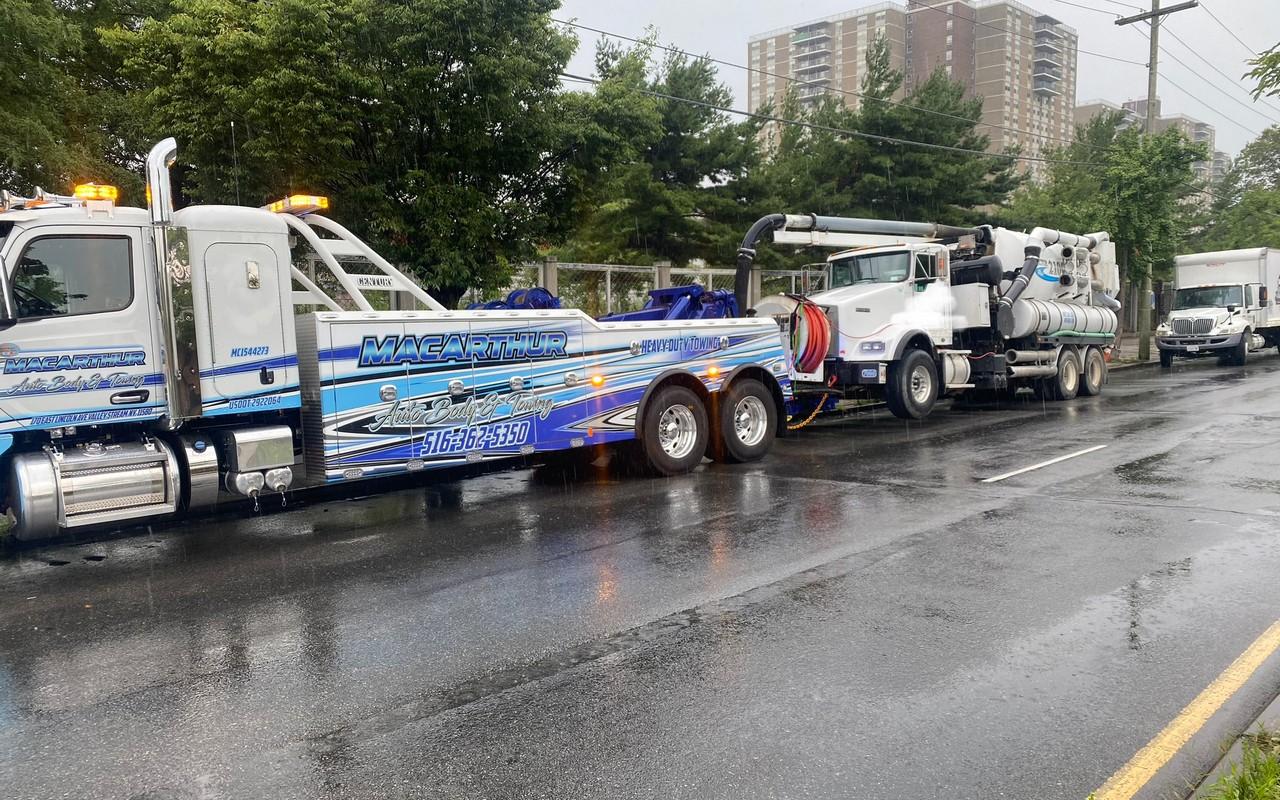
A truck that is down is a truck that is not earning, so commercial towing is about getting the vehicle to the right place with no drama. The heavy wreckers tow straight trucks, cutaways, school and coach buses, dump trucks, and tractor trailers, loaded or empty. Tell us the gross weight, the load, and whether the vehicle is air-brake equipped so the driver brings what he needs to release the brakes and tow it safely. If the truck has gone off the pavement or jackknifed, the wrecker's winch capacity and the driver's experience are what get it back on the road without more damage. The full rundown is on the heavy duty towing page.
For fleet managers, repair shops, and dealerships, a standing account means the person who answers the phone already knows your yard, your preferred shop, and who signs for the vehicle. Repair shops use us to bring in customer cars that cannot be driven. Dealers use us to move inventory between lots and to collect trade-ins that do not run. Property managers call when a vehicle has to move off a lot and the rules allow it. Landscapers and contractors use the flatbed for equipment hauling, moving skid steers, compressors, and lifts between job sites. The commercial towing section on the homepage goes into how accounts are set up; the short version is one phone call to 516-362-5350.
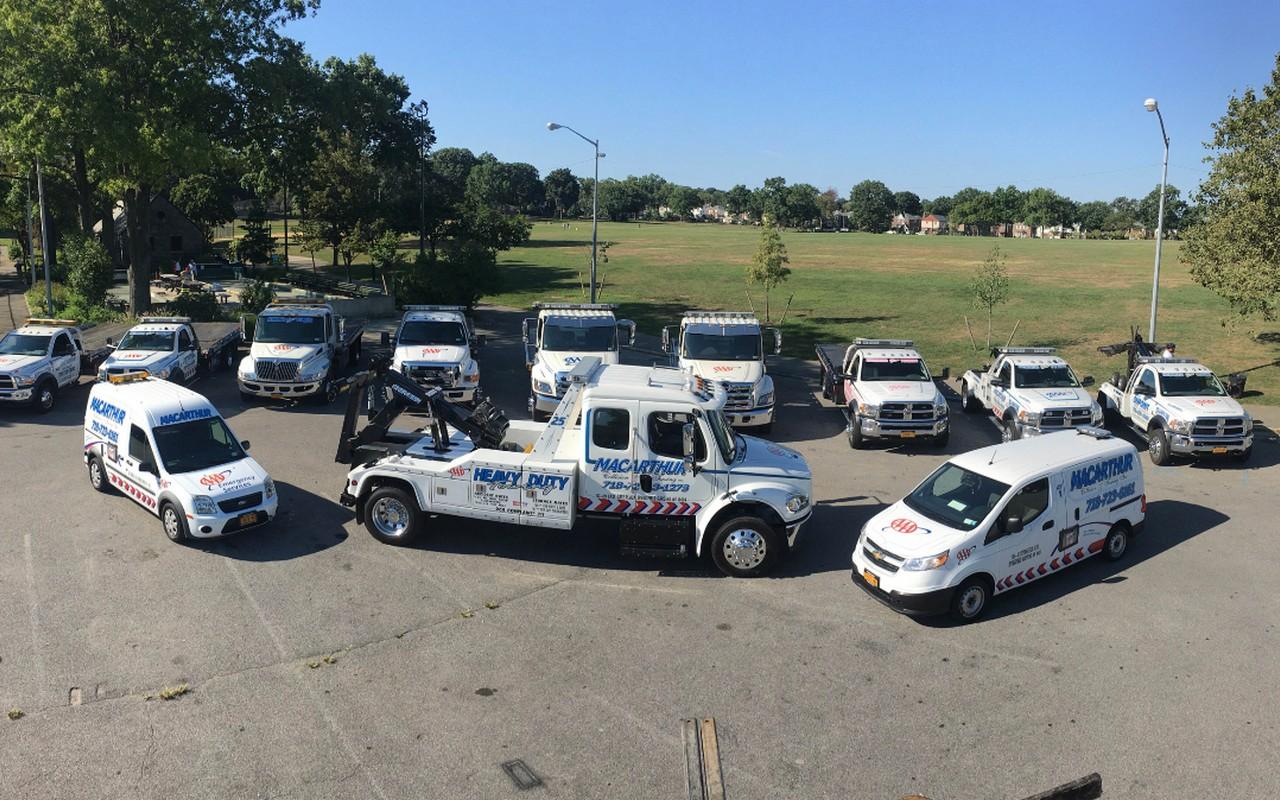
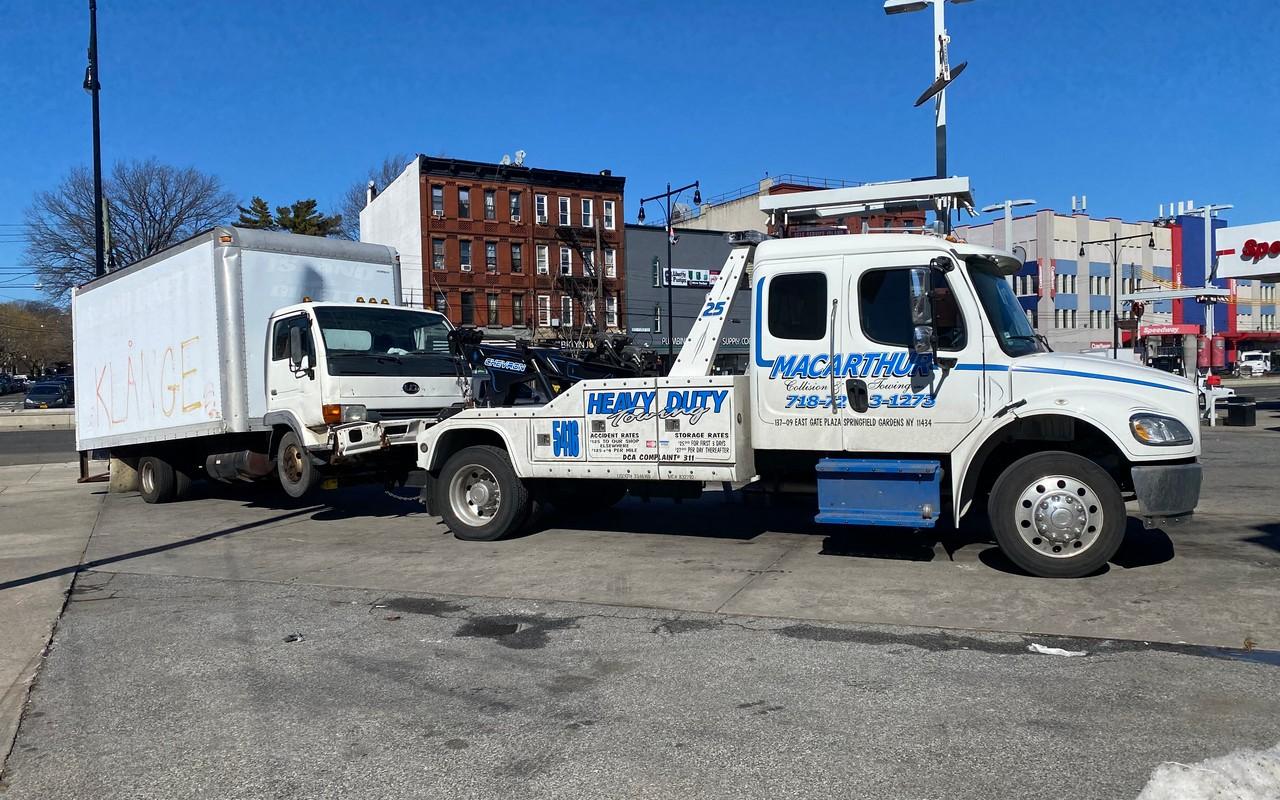
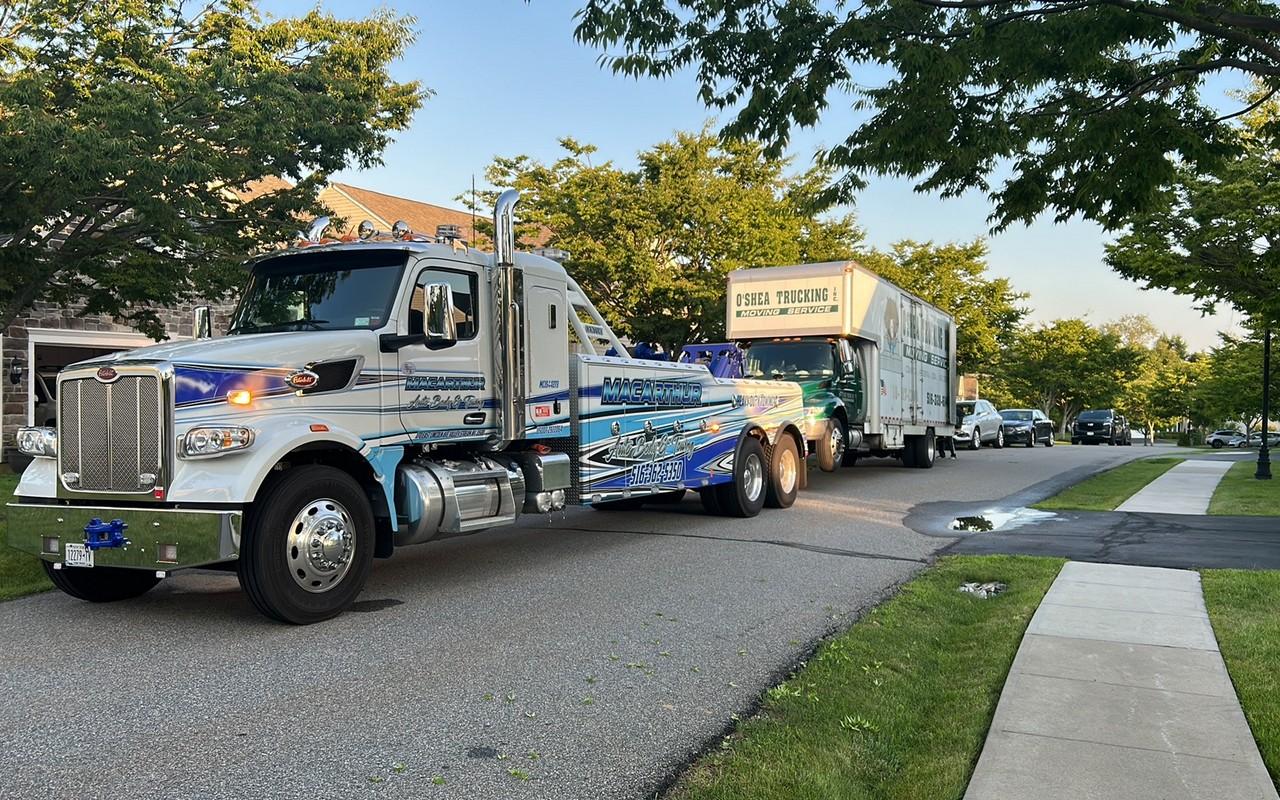
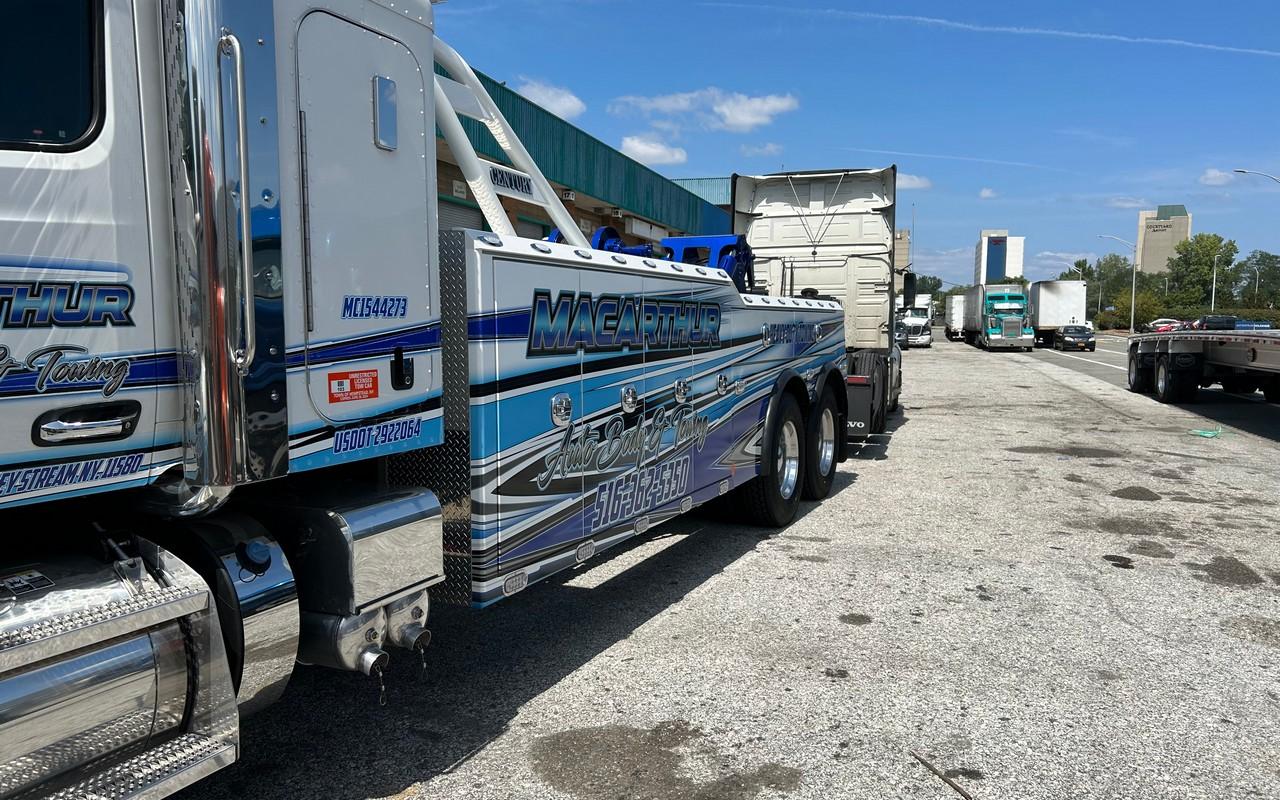
The photos below are our trucks on real jobs, not stock images. The heavy wrecker in the first frame is the one that comes for a tractor trailer.
Run a fleet, a shop, or a lot? Set up an account in one call.
Electric Vehicles, All-Wheel Drive, Motorcycles, Classics, and Lowered Cars: Hookup Details That Protect the Car
Some vehicles are damaged by an ordinary tow. Electric and all-wheel-drive cars must ride on a flatbed with every wheel off the road. Lowered cars need long ramps and sometimes boards. Classics need soft straps and a driver who does not hook to the bumper. Motorcycles ride upright with straps on the frame. Macarthur's drivers do each of these the right way, every time.
This is where owning the trucks and training the drivers shows. A careless tow on one of these vehicles does more damage than the breakdown that caused it.
Electric and hybrid vehicles
An EV's motors turn with the wheels whether the car is on or off, and towing one on two wheels can overheat the motor or generate current the system is not expecting. Every EV we tow rides on the flatbed, in tow mode if the car has one, with the parking brake released. If the battery is fully depleted, the car may not shift into neutral; the driver uses the manufacturer's procedure or skates to get it onto the deck. We also deliver a dead EV to a charger or to your home outlet rather than guessing at a roadside charge. The EV and AWD section on the homepage has more on specific brands.
All-wheel and four-wheel drive
Subaru, Audi quattro, most SUVs, many pickups, and a growing number of sedans. Towing with two wheels on the ground can damage the center differential or transfer case, and the owner's manual for nearly every one says flatbed only. Tell us the make and model and the flatbed comes.
Lowered cars, sports cars, and low front splitters
A flatbed deck has an approach angle, and a car with a low nose will scrape going up it. The driver uses the long ramps, adds boards under the ramps to flatten the angle, or winches the car on slowly from a lower position. If the car has a tow hook that threads into the bumper, bring it or tell us where it is in the trunk kit.
Classic and collector cars
No hooking to bumpers or suspension arms. Soft straps go over the tires, not the painted or chromed parts, and the driver asks before touching anything that looks original. If the car has no working brakes or a frozen transmission, the winch does the work and the car is never pushed.
Motorcycles and scooters
Upright on the deck, front wheel in a chock, soft straps over the triple tree or frame and the rear subframe, compressed just enough to hold the bike without bottoming the suspension. Nothing touches the tank, the fairings, or the bars. The motorcycle towing page has what to tell us about the bike.
Tell us what you drive and the driver brings the right straps and ramps.
Long Distance Towing From Nassau County to the Five Boroughs, Upstate, New Jersey, and Beyond
Macarthur tows vehicles beyond Nassau County on a flatbed: into Queens, Brooklyn, and the other boroughs, east to Suffolk, north into Westchester and upstate, and out of state. Long distance tows are quoted by mileage and vehicle type before the truck leaves, so you know the number up front.
Most of our tows are a few miles. Some are not. A car bought at auction in another county, a college student's car that died two hours away, a collector car going to a specialist shop, a dealer trade between stores, a family moving and taking a non-running second car along. These are flatbed jobs with one driver, one truck, and a quote based on the pickup address, the drop-off address, and what the vehicle is.
Here is what makes a long distance quote accurate. Give us both addresses exactly, including whether the pickup is at a residence, a business, a yard, or an auction with specific hours and paperwork. Tell us whether the vehicle rolls and steers, because a car with locked wheels takes longer to load and may need skates. Tell us whether anyone needs to meet the truck at either end for keys or a signature. And tell us if timing matters, because a long tow is scheduled rather than immediate, and we will tell you honestly what day works.
For a non-running vehicle from a private seller, we can also handle the handoff: confirm the VIN against the title you send us, photograph the car before loading, and deliver it to your driveway. The long distance towing page has more on dealer, auction, and collector car moves.
Send both addresses and the vehicle and we quote the whole trip.
Staying Safe on the Shoulder While You Wait for the Tow Truck
If your car is disabled on a road with traffic, pull as far right as you can, put the hazards on, and get out on the side away from traffic. Stand well off the shoulder, behind a guardrail if there is one, and never stand behind or between vehicles. If you cannot get out safely, stay belted in with the hazards on and wait for the truck.
Tow truck drivers see the aftermath of people standing in the wrong place more often than anyone should. The vehicle is replaceable. Here is what the drivers want you to do while you wait.
Get the car off the travel lane if it still moves. Even a few feet onto the shoulder or into a driveway makes a difference. If it will not move, leave it, do not push it in traffic.
Hazards on, and at night, the dome light too. A dark car on a dark shoulder is invisible until it is too late. If you have a reflective triangle or flares in the trunk and can place them safely behind the car, do it; if placing them means walking in a lane, skip it.
Exit away from traffic. Slide across to the passenger side if you have to. Once out, walk away from the car, uphill or upstream of traffic, and stand behind a barrier if there is one. Do not stand directly behind the car, because that is where a distracted driver hits it.
Keep the phone on and the ringer up. The driver may call to confirm the spot. Stay off the phone otherwise so you can hear traffic.
In bad weather or on a narrow road, stay in the car. Belted, hazards on, doors locked. That is safer than standing on a shoulder that drivers cannot see in rain or snow.
When the truck arrives, let the driver set up. He will position the truck to shield the car from traffic and work from the safe side. Follow his instructions on where to stand. New York's Move Over law requires drivers to slow down and move over for a tow truck with its lights on, but not everybody does, and the driver's setup accounts for that.
Safe spot first, then call. The truck comes to you.
How a Tow Is Priced and How to Get a Quote Before the Truck Rolls
A tow is priced on the distance from pickup to drop-off, the type of vehicle, the truck it needs, whether winching or recovery is involved, and the time of day. Macarthur quotes the tow on the phone from your location, vehicle, and destination before a truck is sent, and the quote is the price unless the job turns out to be different from what was described.
Nobody likes being told "it depends," so here is exactly what it depends on, and what you can do to make the number accurate the first time.
Distance. The miles from where the car is to where it is going. A tow from Elmont to our shop in Valley Stream and a tow from Glen Cove to a dealer in Massapequa are different jobs. Give both addresses and the quote reflects the real distance.
Vehicle and truck. A compact car on a wheel-lift costs less to move than a loaded box truck on a heavy wrecker. Year, make, and model tells us which truck, and for commercial vehicles the weight and load do.
Recovery. Winching a car out of a ditch, off a lawn, out of a snowbank, or back onto its wheels is work done before the tow starts, and it is priced as recovery. Tell us how the car is sitting and we include it.
Time of day. Towing runs 24 hours, and a call at 3 AM on a holiday is not the same as a scheduled pickup on a Tuesday afternoon. We tell you on the phone if the time changes the rate.
Storage. If the car waits at our yard before going to a destination, storage applies by the day. If the car is being repaired at our collision shop, the arrangement is different, and we explain it when the car comes in.
What we do not do is quote low to get the truck there and then add to the bill on the hook. If the job is what you described, the quote is the price. If the driver arrives and finds a different job, a car described as on the street that is actually in a garage with no clearance, or a car that was "in the grass" but is actually in a ditch, he tells you the new number before he touches the car, and you decide. Payment is settled with the driver or the office; ask when you call about how you would like to pay.
Give us both addresses and the vehicle, and the quote comes before the truck.
Towing Service Area From Valley Stream: the South Shore, the Queens Line, Central Nassau, the North Shore, and the Suffolk Border
Macarthur's trucks leave from 170 East Lincoln Avenue in Valley Stream and cover every community in Nassau County, the Queens neighborhoods along the county line, and the Suffolk towns just across it. Every town has its own towing page, and every towing service has a page for every town.
The yard is on the Nassau–Queens line, which puts the south shore and southeastern Queens closest to the trucks. From Valley Stream the fleet covers Lynbrook, Elmont, Franklin Square, West Hempstead, Hempstead, Malverne, Rockville Centre, Oceanside, Baldwin, Freeport, Long Beach, and the Five Towns: Cedarhurst, Lawrence, Woodmere, Hewlett, and Inwood.
Across the county line in Queens, the trucks work Laurelton, Rosedale, Springfield Gardens, Cambria Heights, St. Albans, Queens Village, Hollis, Jamaica, and Far Rockaway, plus Floral Park, Bellerose, Glen Oaks, Little Neck, and Douglaston along the northern stretch of the line.
Central Nassau is Garden City, Mineola, Westbury, Uniondale, East Meadow, Levittown, Hicksville, Plainview, Bethpage, Farmingdale, Merrick, Bellmore, Wantagh, Seaford, and Massapequa. The north shore runs from Great Neck and Manhasset through Port Washington, Roslyn, Glen Cove, Syosset, Jericho, and Oyster Bay. On the Suffolk side of the line we tow in Amityville, East Farmingdale, Melville, Dix Hills, and Huntington.
Every one of those towns has a page for each service, so a driver in Garden City who needs a flatbed, a rider in Freeport who needs motorcycle towing, or a fleet in Hicksville that needs heavy duty towing can see exactly what we bring there. The whole list is on the locations page. If your town is not on it, call anyway; the trucks go where the call is.
Find your town and the towing services we bring there.
Questions Drivers Ask Before They Call for a Tow
- Does Macarthur tow 24 hours a day?
- Yes. Towing and roadside assistance run 24 hours a day, 7 days a week, including holidays. The number is 516-362-5350 at any hour.
- Are the tow trucks your own, or do you send a subcontractor?
- Our own. Macarthur owns its flatbeds, wheel-lift wreckers, and heavy wreckers, and the drivers are Macarthur employees working out of the yard at 170 East Lincoln Avenue in Valley Stream.
- What should I have ready when I call for a tow?
- Your exact location with a cross street or business name, the year, make, and model of the vehicle, and the address it is going to. If the car is damaged or stuck, describe how it is sitting.
- Will you tell me the price before the truck comes?
- Yes. We quote the tow on the phone from your location, vehicle, and destination. If the job on arrival is what you described, the quote is the price.
- Can you tow my car to my own mechanic instead of your shop?
- Yes. We tow to any destination you choose: your mechanic, a dealership, a tire shop, your driveway, an auction, or our collision shop. You are never required to use our body shop.
- Do I need a flatbed or is a wheel-lift fine?
- All-wheel-drive, four-wheel-drive, electric, hybrid, lowered, and damaged vehicles need a flatbed. A front-wheel-drive car that will not start and is going a short distance can go on a wheel-lift. Give us the make and model and we send the right truck.
- Do you tow Teslas and other electric cars?
- Yes, always on a flatbed with all four wheels off the road, which is what EV manufacturers require. We can deliver a depleted EV to a charger or to your home.
- Can I ride in the tow truck with my car?
- Often, yes. It depends on the truck, how many people are with you, and the situation. Ask the driver when he arrives.
- The police called a tow truck I did not ask for. Do I have to use it?
- If your car is not blocking traffic, you can usually tell the officer your own tow company is on the way. If the car has already been towed to another yard, call us and we will collect it from there once the yard releases it to you.
- My car went into a ditch. Can you get it out?
- Yes. The truck winches the vehicle back onto firm ground, checks underneath for damage and leaks, and then loads it. Recovery is priced as part of the job and we tell you on the phone.
- Do you tow motorcycles?
- Yes. Motorcycles ride upright on a flatbed with the front wheel in a chock and soft straps on the frame, never on the tank or fairings.
- Do you tow box trucks and tractor trailers?
- Yes. The heavy wreckers tow straight trucks, buses, dump trucks, and tractor trailers, loaded or empty. Tell us the weight and the load when you call.
- Can you jump start my car instead of towing it?
- Yes. Every truck carries jump packs. The driver jumps the car and tests whether the battery holds a charge. If it does not, he can install a new battery on the spot.
- I locked my keys in the car. Will opening it damage the door?
- No. The driver uses proper lockout tools and opens the door without marking the paint, the lock, or the weather seal. This includes keys locked in the trunk.
- I have a flat and no spare. What happens?
- The car goes on the flatbed to the tire shop you choose. If you do have a usable spare, the driver puts it on and you drive to the tire shop yourself.
- Do you deliver gas if I run out?
- Yes. Fuel delivery brings enough gasoline or diesel to reach the nearest station. Tell us the fuel type when you call.
- Can you tow a car that is stuck in a parking garage?
- Usually. Tell us the garage's clearance height if it is posted. A flatbed does not fit in every garage, so we may send a wheel-lift wrecker instead.
- How far will you tow a car?
- Anywhere on Long Island, into the five boroughs, upstate, into New Jersey and Connecticut, and farther by arrangement. Long distance tows are quoted by mileage and vehicle type and are scheduled rather than immediate.
- Can you pick up a car I bought from a private seller or at auction?
- Yes. Give us the pickup address, the hours, and any paperwork the seller or auction requires. We photograph the vehicle before loading and deliver it to your driveway or your shop.
- If my car comes to your body shop after an accident, do I pay storage?
- A car that came in on our truck for repair waits at our shop while the insurance estimate and approvals are done, and the storage arrangement is explained when the car comes in. There is no separate storage yard and no second tow.
- Do you tow for businesses and fleets?
- Yes. We keep accounts for fleets, repair shops, dealerships, landscapers, contractors, and property managers across Nassau County and Queens. Call 516-362-5350 and ask for fleet service.
- Do you haul equipment like skid steers and lifts?
- Yes. Skid steers, small excavators, compressors, forklifts, and scissor lifts ride on a flatbed with chains and binders. Tell us the make, model, and weight of the piece.
- What should I do while I wait for the tow truck on a busy road?
- Get the car as far right as it will go, put the hazards on, exit on the side away from traffic, and stand well off the shoulder behind a barrier if there is one. If you cannot get out safely, stay belted in with the hazards on. Keep your phone on so the driver can reach you.
- Which towns does Macarthur tow in?
- All of Nassau County, the Queens neighborhoods along the Nassau line such as Laurelton, Rosedale, Springfield Gardens, Jamaica, and Far Rockaway, and the Suffolk towns just over the border such as Amityville, Melville, and Huntington. Every town has its own page on this site.
- Is Macarthur licensed to tow?
- Yes. Macarthur Auto Body and Towing operates under New York State DMV number 7110205 and New York City Department of Consumer Affairs license number 1389419.
- Are you hiring tow truck drivers?
- Yes. Light duty drivers and heavy duty wrecker operators are listed on the tow truck driver jobs page, and you can call 516-362-5350 and ask for the shop manager.
Did not see your question? The person who answers can.
Call Macarthur for a Tow Truck Anywhere in Nassau County
Our own trucks, our own drivers, 24 hours a day. Tell us where you are, what you drive, and where it is going.
Call 516-362-5350