Roadside Assistance
Roadside Assistance That Fixes It Where You Stand, and Tows You If It Can't
Most breakdowns do not need a tow. A dead battery, keys locked inside, a flat with a usable spare, or an empty tank can be fixed where the car sits. Macarthur sends a truck with jump packs, lockout tools, a jack, and fuel, 24 hours a day across Nassau County and the Queens line, and if the problem turns out to be bigger, the same truck tows you. Call 516-362-5350.
Reviews and credentials
What Drivers Say About Macarthur's Roadside Calls
A roadside call is usually a small problem at a bad time, and the reviews drivers leave on Google are about how the driver handled it: quick with a lockout on a snowy night, honest about whether the battery would hold, patient with a flat in a parking lot. Those reviews are below, in the customers' own words.
I got locked out my car on a cold snowy night and Alex came and unlock my car. He was very quick and professional. I would definitely use this towing company again.
Great timing and professionalism. The tow truck driver Carlos was experienced and helpful. I would recommend this company and Carlos to anyone.
Not the usual experience with a towing company. Everyone that I spoke to was polite and respectful and they towed my car with care. Hopefully I never need my car towed again, but if I do, this is who I will be using!
- 1,800+Google reviews, 5.0 average as of Oct 2026
- 24/7Our own trucks, our own drivers
- 16Certifications on the shop wall
- I-CARGold Class training recognition
- 1 ShopTow fleet and body shop, Valley Stream
- LicensedDMV # 7110205 · DCA # 1389419
Every review here came from a towing or roadside call. If a Macarthur driver got you going again at the curb, a few words on Google tell the next driver with a dead battery who to call.
The truck that fixes it is the truck that tows if it can't.
- Roadside Assistance
- Roadside Service
- Jump Start
- Lockout
- Flat Tire
- Tire Change
- Fuel Delivery
- Battery Service
- Emergency Roadside
- 24 Hour Roadside
- Tow Truck
- Towing
What Roadside Assistance Covers at Macarthur, and What Each Truck Carries to Do It
Roadside assistance at Macarthur covers the four problems that strand most drivers: a dead battery, keys locked in the car, a flat tire, and an empty tank. Every truck carries jump packs and a battery tester, lockout tools, a jack and lug wrench, and gasoline and diesel. On top of that, the trucks carry new batteries for common cars so a battery that will not hold a charge is replaced on the spot.
Roadside assistance is about a third of what Macarthur's trucks do on a given day, and it is the part of the business where the right answer is usually the cheaper one. If a jump gets you going, we jump you. If the spare is good, we put it on. Nobody is towed to a shop to be told the battery was dead.
Here is what is on the truck and what it means for you. Jump packs and a tester. The jump pack starts the car; the tester tells you whether the battery will hold a charge or die again tomorrow. New batteries. Common sizes ride on the truck, so a dead battery becomes a mobile battery installation without a second visit. Lockout tools. Wedges, long-reach tools, and the know-how to open a door without marking paint or tearing the weather seal. Jack, lug wrench, and a breaker bar. For a spare tire change, including seized lug nuts and locking lugs if you have the key. Fuel. Enough gasoline or diesel to reach a station. And the deck. Every roadside truck is a tow truck, so when the problem is more than the curb can fix, the tow starts from the same truck without a second call.
The sections below walk through each of the four problems, what the driver does, when it turns into a tow, and what to have ready when you call 516-362-5350.
Stuck with something small? Say what happened and the truck brings the right gear.
Dead Battery at the Curb: the Jump, the Test, and the New Battery if It Will Not Hold
The driver connects a jump pack, starts the car, and then tests the battery and the charging system. If the battery holds a charge, you drive away. If it does not, or it is swollen, leaking, or several years old, the driver can install a new battery right there from the stock on the truck, and the old one goes back for recycling.
A dead battery is the most common roadside call we get, and the question that matters is not whether the car will start but whether it will start again tomorrow. A jump alone answers the first question. The test answers the second.
The driver checks the resting voltage, then the voltage with the engine running, which tells him whether the alternator is charging. A battery that reads low after a jump and a drive is on its way out. A battery that reads fine but the charging voltage is low means the alternator is the problem, and that is a shop repair; the driver tells you and can tow you to your mechanic. The jump starts page explains the testing, and the mobile battery installation page covers the new battery, including why the car's year, make, and model matter so the right size is on the truck.
Electric vehicles have a small 12-volt battery that runs the electronics, and when it dies the car will not wake up, shift, or sometimes unlock. The driver uses the manufacturer's jump point to revive it; if the main battery is depleted, that is a flatbed to a charger.
Car clicks but will not start? The truck jumps it and tests it.
Locked Out: Opening the Car Without a Mark on the Paint, the Lock, or the Seal
A Macarthur driver opens a locked car with proper lockout tools: a wedge to make a small gap at the top of the door, a long-reach tool to work the lock or the handle, and no force. The paint, the lock, and the weather seal are left as they were. Keys locked in the trunk are reached by opening the car and using the interior release or the fold-down seat.
A lockout is the call people are most nervous about, because everyone has seen a coat hanger scratch a door. That is not how it is done. The wedge is soft, the gap is small, and the tool reaches the lock button, the handle, or the unlock switch without touching anything painted.
What the driver needs to know: whether the keys are in the cabin or the trunk, whether the car has an alarm, and whether the doors use a push-button lock or a switch. Some newer cars with keyless entry will not unlock from the inside with the fob locked in the trunk, and those take a little longer. If the keys are not in the car at all, we cannot make a new key; we open the car if that helps and tow it to your dealer or a locksmith. The car lockouts page goes into each of these.
If a child or a pet is locked inside, call 911 first, then us. On a hot or cold day minutes matter, and the fire department can open a car faster than a tow truck can get there.
Keys on the seat? The driver opens it without a mark.
Flat Tire: the Spare Goes On if You Have One, and the Flatbed Comes if You Do Not
If your car has a usable spare, the driver jacks the car, swaps the spare on, torques the lugs, and you drive to a tire shop. If there is no spare, the spare is flat too, the wheel is bent, or the tire shredded to the rim, the car goes on the flatbed to the tire shop you name. Many newer cars have no spare, so tell us when you call.
A flat is simple when the spare is good and the lug nuts come off. It is not simple when the car has no spare, when the spare has sat flat for five years, when the lug nuts were put on with an impact gun and will not budge, or when the wheel itself is damaged. The driver carries a breaker bar and a torque wrench for the first problems and a flatbed for the rest.
Locking lug nuts need the key, which is usually in the glove box or the trunk kit; find it while you wait. Run-flat tires can be driven a short distance at low speed to a shop, but not far and not fast, and if you are unsure, the tow is cheaper than a destroyed wheel. The tire changes page covers spares, donuts, run-flats, and the no-spare situation. If the car has to be towed, we take it to whichever tire shop you prefer in Valley Stream, Hempstead, or anywhere else in the county.
Flat with a spare in the trunk? The driver puts it on.
Out of Gas: Fuel to Reach the Pump, and What to Do if the Car Will Not Restart
The driver brings enough gasoline or diesel to reach the nearest station, adds it, and helps the car restart. A gasoline engine that ran dry usually starts after a few seconds of cranking; a diesel may need its fuel system primed, and the driver knows the procedure for common engines. If the wrong fuel went in, do not start the car; it needs a tow to a shop to have the tank drained.
Running out of gas is embarrassing and completely normal. The gauge was optimistic, the station was closed, the detour was longer than it looked. Tell the person who answers which fuel the car takes and the driver brings it.
Two things catch people out. First, a modern car that runs completely dry can pull air into the fuel system and refuse to start even after fuel goes in; the driver cycles the pump and gives it time, and in the rare case it still will not catch, the same truck tows it. Second, putting gasoline into a diesel or diesel into a gasoline car is not fixed by adding the right fuel on top; the tank has to come down and be drained, and starting the engine makes it worse. If that happened, leave it off and we tow it to your mechanic. The fuel delivery page covers both.
Gauge lied? Tell us gas or diesel and the truck brings it.
When Roadside Assistance Becomes a Tow, and Why You Do Not Pay for Two Trucks
Roadside assistance ends where a lift or a diagnostic computer begins. If the battery is fine but the starter is dead, if the spare is flat too, if the car ran dry and still will not fire, or if the engine overheated, the driver says so and the tow starts from the same truck. You are not charged for a wasted roadside visit and then a separate tow.
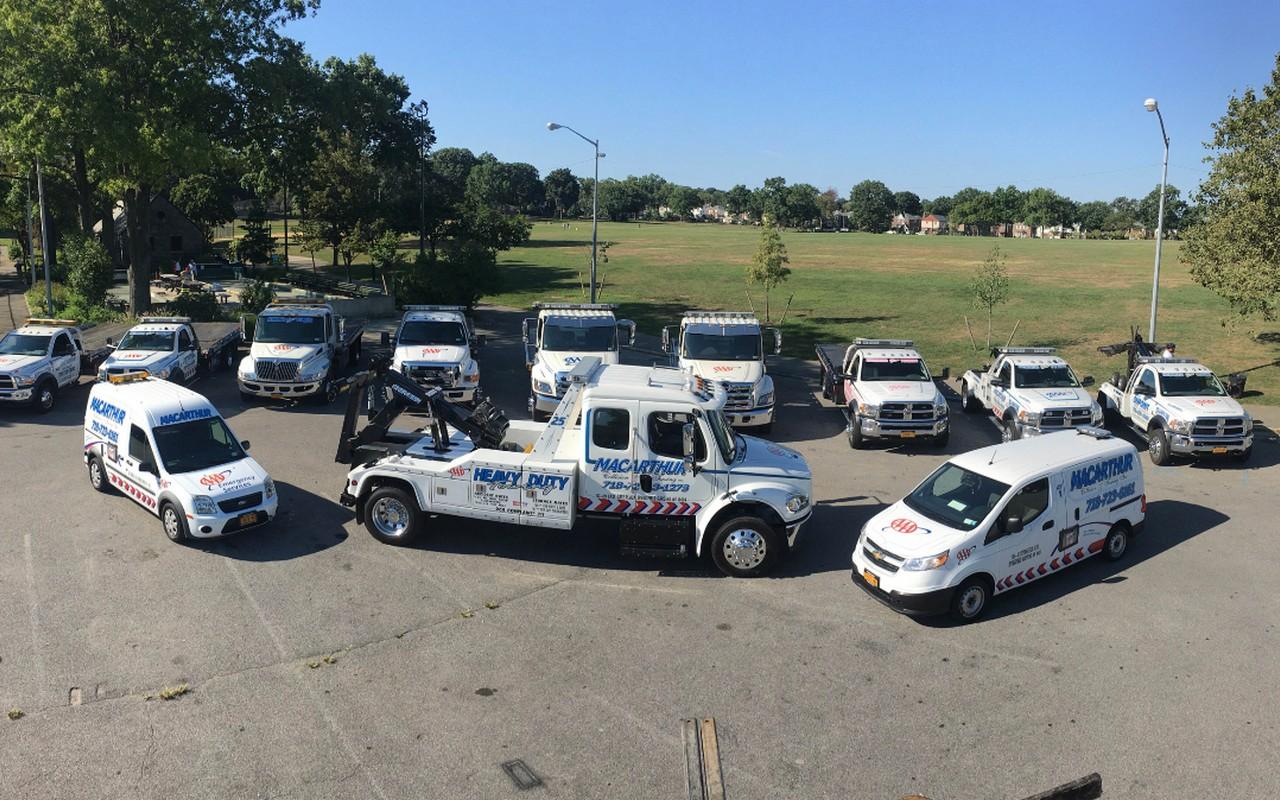
Every Macarthur roadside truck is a tow truck. That is the whole point of sending one. A roadside-only service has to call a tow company when the jump does not work, and you pay twice and wait twice. Here, the driver who tried the jump is the driver who loads the car.
What tips a call from roadside to tow: a good battery with a bad starter or alternator; a flat with no usable spare or a bent wheel; a car that ran dry and will not restart after fuel and priming; an overheated engine, which should not be driven even a mile; a transmission that will not engage; a warning light with the car bucking or losing power; or a lockout where the keys are not actually in the car. In each case the driver tells you what he found and where the car can go: your mechanic, a tire shop, a dealership, or our own shop in Valley Stream. The breakdown towing section on the towing page covers each of these failures in more depth, and the destinations section covers where the car can go.
If the curb cannot fix it, the same truck tows it. One call either way.
What to Tell Us When You Call for Roadside Assistance, and What to Do While You Wait
Tell us where you are with a cross street or a business name, what the car is, and what happened: will not start, locked out, flat, or out of gas. For a battery call, say whether the car clicks or does nothing. For a lockout, say where the keys are. For a flat, say whether you have a spare. For fuel, say gas or diesel. Then stay somewhere safe with your phone on.
The more precisely you describe the problem, the more likely the driver has what he needs on the first trip. Year, make, and model tells him which battery size to bring and which lockout tool works on your door. Whether the car clicks, cranks, or is silent tells him battery versus starter. Whether you have a spare tells him jack or flatbed.
While you wait: if you are on a road with traffic, get out on the side away from traffic and stand well back, behind a barrier if there is one. If it is raining, snowing, or the road is narrow, stay in the car belted with the hazards on. Keep your phone on and the ringer up. Have the keys, if you have them, and your license within reach. Find the locking lug key or the tow hook if you know where they are. The safety section on the towing page goes through this in detail, and the call section covers what the driver does on arrival.
Location, vehicle, and what happened. That is the whole call.
How Roadside Assistance Is Priced, and Why a Fix at the Curb Is the Cheapest Outcome
A roadside call is priced on the service performed, the distance the truck travels, and the time of day. A jump, a lockout, a tire change, or a fuel delivery is a smaller job than a tow, and if it solves the problem, that is the bill. If it does not and the car is towed, the tow is quoted before the car is loaded and you are not charged for two separate trucks.
We would rather jump your car in a parking lot than tow it to a shop that charges you to say the battery was dead. The roadside visit is the cheaper outcome for you and the quicker one for us, so the driver tries it first whenever the problem might be fixable.
What moves the number: how far the truck travels to reach you, the hour, and whether a part is involved, a new battery for example, which is priced with the installation. If the call becomes a tow, the tow is priced on distance, vehicle, and destination like any other, and the towing cost section explains those factors. Give the person who answers your location and what happened, and you get the number before the truck leaves.
Say what happened and where, and you get the number before the truck rolls.
Roadside Assistance Across Nassau County and the Queens Line, From Valley Stream
Macarthur's roadside trucks leave from 170 East Lincoln Avenue in Valley Stream and cover every town in Nassau County, the Queens neighborhoods along the county line, and the Suffolk towns just across it, 24 hours a day. Every town has its own roadside assistance page.
From the yard on the Nassau–Queens line, the trucks are closest to the south shore and southeastern Queens: Valley Stream, Lynbrook, Elmont, Franklin Square, West Hempstead, Hempstead, Malverne, Rockville Centre, Oceanside, Baldwin, Freeport, Long Beach, Island Park, East Rockaway, Cedarhurst, Lawrence, Woodmere, and Hewlett, and across the line in Laurelton, Rosedale, Springfield Gardens, Cambria Heights, St. Albans, Queens Village, Jamaica, and Far Rockaway.
The same trucks cover central and eastern Nassau, Garden City, New Hyde Park, Mineola, Westbury, Uniondale, East Meadow, Levittown, Hicksville, Bethpage, Merrick, Wantagh, and Massapequa, the north shore from Great Neck and Manhasset to Glen Cove and Syosset, and the Suffolk border towns of Amityville, Melville, and Huntington. Every town on the locations page has a roadside assistance page. If yours is not listed, call anyway.
Find your town and its roadside assistance page.
More Towing Services From the Same Fleet
Towing
24/7 towing for cars, trucks, and everything in between.
Light Duty Towing
Cars, SUVs, vans, and pickups on flatbeds and wheel-lifts.
Heavy Duty Towing
Trucks, buses, semis, and tractor trailers, safely and securely.
Flatbed Towing
All four wheels off the ground for AWD, EV, and low vehicles.
Motorcycle Towing
Special care for your two-wheeled pride and joy.
Long Distance Towing
Convenient and economical long distance towing for any vehicle.
One number covers every truck in the fleet.
Questions Drivers Ask About Roadside Assistance
- What does roadside assistance include?
- Jump starts with a battery test, new battery installation if yours will not hold a charge, car lockouts, spare tire changes, and fuel delivery. If the problem needs a shop, the same truck tows you.
- Is roadside assistance available 24 hours a day?
- Yes. Roadside assistance and towing run around the clock, every day, including holidays. Call 516-362-5350.
- Can you jump start my car?
- Yes. The driver jumps the car and tests whether the battery and charging system are healthy. If the battery will not hold a charge, a new one can be installed on the spot.
- What if the jump start does not work?
- The driver checks whether the problem is the battery, the starter, or the alternator and tells you. If the car needs a shop, the same truck tows it to your mechanic or to our shop.
- I locked my keys in the car. Will you damage the door?
- No. The driver uses a soft wedge and a long-reach tool and opens the door without marking the paint, the lock, or the weather seal.
- My keys are locked in the trunk. Can you get them?
- Yes. The driver opens the car and uses the interior trunk release or the fold-down seat to reach the trunk.
- I lost my keys entirely. Can you make a new one?
- No. We open the car if that helps and tow it to your dealer or a locksmith who can cut and program a key.
- A child or pet is locked in the car. What do I do?
- Call 911 first. The fire department can open a car faster than any tow truck can arrive. Then call us if you still need the car opened or moved.
- I have a flat. Will you change it?
- Yes, if you have a usable spare. The driver jacks the car, swaps the spare on, and torques the lugs. If there is no spare or the wheel is damaged, the car goes on the flatbed to a tire shop.
- My car has no spare tire. What happens?
- We tow the car to the tire shop you choose. Many newer cars have no spare, so tell us when you call and the flatbed comes.
- Do you deliver gas and diesel?
- Yes. Tell us which fuel the car takes. The driver brings enough to reach a station and helps the car restart.
- I put the wrong fuel in my car. Can you help?
- Do not start it. Adding the right fuel on top does not fix it; the tank has to be drained at a shop. We tow the car to your mechanic.
- Do you do roadside assistance for electric cars?
- Yes. A dead 12-volt battery can be revived at the manufacturer's jump point. A depleted main battery means a flatbed to a charger or your home.
- Will I be charged twice if the roadside fix does not work and I need a tow?
- No. The tow starts from the same truck, is quoted before the car is loaded, and you are not billed for a separate second truck.
- What should I tell you when I call?
- Where you are with a cross street or business name, the year, make, and model, and what happened: will not start, locked out, flat, or out of gas. Details like whether the car clicks or whether you have a spare help the driver bring the right gear.
Did not see your question? The person who answers can.
Call Macarthur for Roadside Assistance Anywhere in Nassau County
Jump, lockout, flat, or fuel, fixed where you stand. And if it cannot be, the same truck tows you.
Call 516-362-5350