Equipment Hauling
How Macarthur Hauls Skid Steers, Lifts, and Compressors Between Job Sites
Contractors and landscapers call Macarthur to move the machines that do the work: skid steers, mini excavators, towable compressors, forklifts, scissor lifts, and the small plant that rides on a flatbed. Our own trucks pick the piece up at one job site or yard, chain and bind it to the deck, and set it down at the next. Call 516-362-5350 with the make, model, and weight.
Reviews and credentials
What Drivers Say About Macarthur's Trucks and Drivers
A contractor judges a hauler by whether the machine arrived on time, undamaged, and set down where the crew could use it. Macarthur's reviews on Google come mostly from car and truck calls, but they describe the same drivers and the same trucks that move equipment: careful hookups, straight answers, and no drama. Those reviews are below.
I got locked out my car on a cold snowy night and Alex came and unlock my car. He was very quick and professional. I would definitely use this towing company again.
Great timing and professionalism. The tow truck driver Carlos was experienced and helpful. I would recommend this company and Carlos to anyone.
Not the usual experience with a towing company. Everyone that I spoke to was polite and respectful and they towed my car with care. Hopefully I never need my car towed again, but if I do, this is who I will be using!
- 1,800+Google reviews, 5.0 average as of Oct 2026
- 24/7Our own trucks, our own drivers
- 16Certifications on the shop wall
- I-CARGold Class training recognition
- 1 ShopTow fleet and body shop, Valley Stream
- LicensedDMV # 7110205 · DCA # 1389419
Every review here came from a towing or roadside call. If Macarthur has moved your machine between jobs, a few words on Google tell the next contractor with a skid steer stuck at the wrong site who to call.
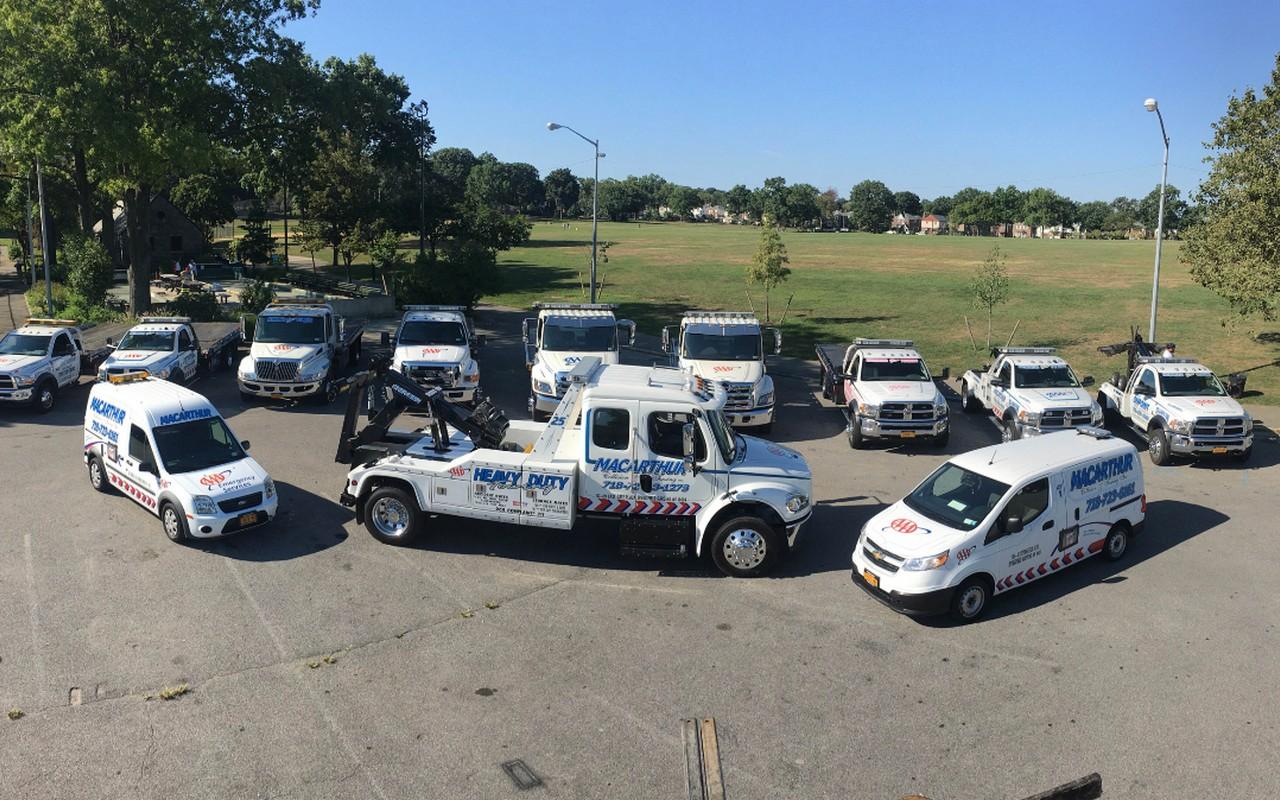
The same trucks that tow cars carry the machines. Same drivers, same care.
- Equipment Hauling
- Equipment Towing
- Skid Steer Hauling
- Flatbed Hauling
- Machinery Hauling
- Forklift Towing
- Lift Hauling
- Construction Hauling
- Landscaping Equipment
- Job Site Hauling
- Flatbed
- Commercial Towing
What Rides on a Macarthur Flatbed: Skid Steers, Mini Excavators, Compressors, Forklifts, Lifts, and Attachments
Macarthur's flatbeds carry the compact and mid-size equipment that contractors, landscapers, and property managers use every day: skid steers and track loaders, mini excavators, towable air compressors and generators, warehouse forklifts, scissor lifts, small rollers and plate compactors, and the buckets, augers, and forks that go with them. Anything heavier or taller than the flatbed can safely carry goes to the heavy wrecker or a referral.
The flatbed's deck is rated for a certain weight and a certain length, and most of what a local contractor runs fits inside it. Here is what we move routinely and what we need to know for each.
Skid steers and compact track loaders
The most common piece we haul. Wheeled skid steers drive onto the deck under their own power; tracked loaders do the same but need the deck protected from the track lugs on some models. The bucket or attachment usually stays on and is lowered flat to the deck and chained separately. Tell us the model so we know the operating weight, because a large frame track loader with a full bucket is heavier than it looks.
Mini excavators
Driven up the ramps with the boom folded and the blade raised, then the boom is lowered to the deck and the blade dropped as a brace. The swing lock goes on so the house cannot rotate during the haul. Weight varies widely by class; give us the model.
Towable compressors, generators, and light towers
These have their own trailer axle and can be towed behind a truck with the right hitch, or lifted onto the deck when the trailer tires or lights are not road-worthy. Tell us which, because a compressor with a flat trailer tire is a flatbed job, not a tow-behind.
Forklifts and scissor lifts
Warehouse forklifts are heavy for their size, with most of the weight in the counterweight, and they ride with the mast lowered and the forks tilted back. Scissor lifts ride collapsed and chained at the chassis, never at the platform. Both need a firm surface at pickup and drop-off to drive on and off.
Rollers, compactors, trenchers, and small plant
Walk-behind and ride-on rollers, plate compactors, trenchers, stump grinders, and chippers that are not trailer-mounted. Most are winched or driven aboard and chained at the frame.
Attachments on their own
Buckets, grapples, augers, pallet forks, and breakers can ride alongside the machine or on their own, chained flat so they cannot shift. The heavy duty towing page covers the trucks and trailers that carry what the flatbed cannot.
Not sure your machine fits? Give us the make and model and we will say.
What We Need to Know Before the Truck Leaves: Make, Model, Weight, Attachments, Fluids, and Whether It Runs
To send the right truck and the right tie-downs, Macarthur needs the machine's make and model, its operating weight if you know it, what attachments are on it, whether it runs and drives, and whether any fluids are leaking. We also need the two addresses, who is meeting the truck at each end, and what the ground is like where the machine sits.
An equipment move is quoted and planned from a short list of facts. Give them to the person who answers and the move goes right the first time.
Make, model, and weight. The operating weight on the data plate or in the spec sheet decides whether the flatbed can carry it and how it is chained. A skid steer model number tells us more than a description; two machines that look alike can differ by a thousand pounds.
Attachments. A bucket adds weight and changes how the machine sits on the deck. A breaker or auger needs its own tie-down. A forestry head or a wide brush cutter can exceed the deck width and needs to be removed before loading.
Does it run and drive? A machine that drives onto the deck is a quick load. A dead machine is winched, and a dead tracked machine or a forklift with locked wheels may need skates or a second approach. Tell us so the driver brings what he needs.
Leaks and condition. Hydraulic fluid on a deck is a hazard for the driver and the next machine. If the piece is leaking, say so and the driver brings absorbent and pads it. A machine with a cracked frame or failed brakes is chained accordingly.
Both addresses and both contacts. A job site with a gate code, a yard that closes at four, a lot where the machine has to be set down in a specific spot. Who is there at each end, and how do we reach them if the truck is early or late. The what to tell us section on the towing page covers the phone call for any tow, and the same applies here.
Timing. Most equipment moves are scheduled, not immediate. Tell us when the machine needs to be at the next site and we tell you honestly what day and window works. A machine down on a live job is treated as the emergency it is.
Have the data plate photo ready and the quote is accurate the first time.
Chains, Binders, and Edge Protection: How the Machine Is Secured So It Arrives the Way It Left
A machine on a flatbed is held by chains and binders at the manufacturer's tie-down points, with the attachment lowered and chained separately, the parking brake set, and the hydraulics locked. The driver tensions the chains in opposing directions so the machine cannot move forward, backward, or sideways, and checks them again after the first few minutes of driving.
Cars are strapped at the tires. Equipment is chained at the frame, and the method matters because a skid steer that shifts on a deck can take the deck's rail with it.
Tie-down points. Most machines have marked lifting and tie-down points on the frame, and those are what the chains go to, not the axle, the loader arms, or the roll cage. The driver knows the common machines and reads the decals on the rest.
Four-corner chaining. A chain at each corner, run so that opposite chains pull against each other. Binders tension each one so there is no slack. Four chains hold a machine against braking, acceleration, and cornering; a single cross chain does not.
Attachments and movable parts. The bucket, blade, boom, or forks are lowered to the deck and chained or strapped separately so they cannot swing or rise. On an excavator the swing lock and the boom lock go on. On a forklift the mast is lowered and tilted back.
Brakes, hydraulics, and keys. Parking brake set, hydraulic lockout engaged where the machine has one, key removed and handed to the driver or kept with the machine as you prefer.
Edge protection and padding. Chains over a painted surface or a hydraulic line are padded. Tracks sit on protected sections of the deck where the machine has aggressive lugs.
The recheck. After the first few minutes on the road, the driver stops and checks every binder. Chains settle as the machine shifts on its tires or tracks, and that first recheck is where any slack shows up. The how we pick the truck section explains why the flatbed, and not a wheel-lift, is the only truck for this work.
Your machine rides chained at four corners and checked twice. That is the standard.
Job Site Access: Soft Ground, Tight Gates, Slopes, and Where the Machine Gets Set Down
A flatbed needs firm ground to extend its deck, a straight line to load, and room to set the machine where the crew can use it. Before the truck arrives, Macarthur asks about the surface, the gate width, the slope, and overhead lines, and the driver walks the spot before he backs in. If the site cannot take a flatbed, the machine meets the truck at the curb or the nearest firm pad.
Most of the problems with an equipment move are at the ends, not on the road. Here is what the driver looks at and what you can do ahead of time.
The surface. A loaded flatbed sinks into soft lawn, fresh fill, or mud, and a stuck tow truck is a bad day for everyone. Gravel, pavement, compacted base, or dry firm ground is what the truck needs. If the machine is in the middle of a soft site, drive it to the firm edge before the truck arrives if it runs.
Gates, fences, and overhangs. The truck is wide and tall. A residential driveway gate, a low tree limb, or a carport roof stops it. Tell us the gate width and anything overhead, and the driver plans where to load. Overhead power lines near the loading spot are a hard stop; the deck and a raised boom both get close to them.
Slope. Loading on a slope means the machine rolls or slides on the deck before it is chained. The driver positions the truck so the deck tilt works with the slope rather than against it, or finds a flatter spot within reach.
Where it goes at the other end. A machine set down in the wrong corner of a job site has to be moved again by someone. Tell the driver where the crew wants it and whether it should face a particular way, and have someone there who can say so.
Curbside handoff. When a site cannot take the truck, the machine drives to the curb or a firm pad to meet it. That is normal and the driver will tell you on the phone if he thinks it is likely from the description. The commercial accounts section on the towing page covers how repeat moves for the same crew are set up so these details are already on file.
Describe the site and the gate and the driver plans the load before he arrives.
Landscapers, Contractors, Rental Yards, and Property Managers: Who Calls for Equipment Hauling and Why
Landscapers move skid steers and compactors between properties in a season. Contractors move mini excavators and lifts from job to job and back to the yard. Rental yards deliver and collect machines when their own trucks are out. Property managers and facilities move forklifts and lifts between buildings. Macarthur hauls for all of them, on a schedule or on a call.
Equipment hauling is a trade service, and the people who use it have the same two needs: the machine where it should be, when it should be, without a hassle at either end.
Landscapers and hardscapers. A skid steer that finishes a paver patio in one town on Thursday and starts a retaining wall in another on Monday. Plate compactors, trenchers, stump grinders, and the attachments that go with them. Spring and fall are the heavy seasons, and a standing account means the yard already knows your machines.
General and specialty contractors. Mini excavators for footings and drainage, scissor lifts and small booms for interior work, compressors and generators that outlast the trailer they came on. The move is usually scheduled around a trade's start date, and we tell you honestly what we can hold to.
Rental yards and dealers. Delivery and pickup when the yard's own trucks are booked, a machine that broke on a customer's site and has to come back for service, a sold unit going to the buyer. We photograph the machine before loading for both parties.
Property managers and facilities. A forklift going between warehouses, a scissor lift moving from one building to another, snow equipment staged before a storm. One phone number and a driver who knows the loading dock.
Machines that broke down. A skid steer with a dead engine, a lift with a hydraulic failure, a forklift that will not start. These are winched aboard and taken to the dealer or the shop you name. It is the same job as a breakdown tow for a car, with chains instead of straps.
Run equipment for a living? One account covers every move.
What the Flatbed Cannot Carry, and What Macarthur Does Instead
A flatbed has a weight rating, a deck length, and a width, and a machine that exceeds any of them does not go on it. Full-size excavators, large dozers and loaders, and anything taller or wider than the deck allows are outside the flatbed's limits. Macarthur tells you on the phone when a piece is too much for the truck and, where the heavy wrecker or a towed trailer fits the job, sends that instead.
The honest answer to a hauling request is sometimes no, and it is better to hear that on the phone than at the site.
Weight. The deck is rated for compact and mid-size equipment. The operating weight on the data plate, plus the attachment, decides it. If the machine is at the edge of the rating, the driver confirms before loading, because the rating includes a margin for chaining and braking that we do not spend.
Length and width. A machine longer than the deck or wider than the truck's legal width is not a flatbed job. Some attachments can be removed to bring a machine within limits; a wide brush cutter or a forestry head is the usual example.
Height. The machine's height plus the deck's height has to clear overpasses and tree limbs on the route. A tall lift or a machine with a raised cab is checked against the route before we commit.
Tracked machines and deck protection. Steel tracks and aggressive rubber lugs chew a deck. We protect the deck or decline the move depending on the machine.
Trailer-mounted equipment. A compressor, light tower, or chipper on its own road-legal trailer is often better towed behind a truck than lifted. Tell us the condition of the trailer's tires, lights, and hitch, and we choose.
When it is beyond us. For large plant, oversize loads, or anything that needs a lowboy and permits, we say so. The heavy duty towing page covers the trucks, buses, and trailers the heavy wrecker handles, which is a different job from hauling a machine on a deck.
Give us the weight and the dimensions and we tell you honestly if it rides.
How an Equipment Move Is Priced: Distance, Weight, Loading Conditions, and Scheduling
An equipment move is priced on the distance between the two sites, the weight and type of machine, how it loads, whether it runs or has to be winched, and when it needs to happen. Macarthur quotes the move on the phone from the make, model, and both addresses, and the quote is the price unless the job on site is different from what was described.
A contractor needs the number to bill the job, so here is what goes into it and how to make it exact.
Distance. Pickup address to drop-off address. A move across town and a move across the county are different jobs.
The machine. Weight and type decide the tie-down work and the truck. A plate compactor and a track loader are not the same line.
Loading conditions. A machine that drives onto the deck on pavement loads quickly. One that is dead, on soft ground, behind a tight gate, or on a slope takes more time and sometimes a second approach, and that is in the quote when we know about it.
Attachments and extras. A bucket that rides with the machine is normal. A second attachment, or an attachment that has to be removed to fit, is noted.
Scheduling. A move booked for a specific window on a weekday and an emergency move at night for a machine blocking a live site are priced differently, and we say which on the phone.
No surprises at the site. If the driver arrives and the machine is heavier, the ground is softer, or the gate is tighter than described, he tells you the new number before he loads. The cost section on the towing page explains how every Macarthur quote is built.
Both addresses, the model, and the date get you a quote you can bill against.
Equipment Hauling Across Nassau County and the Queens Line, From the Yard in Valley Stream
Macarthur's flatbeds leave from 170 East Lincoln Avenue in Valley Stream and reach job sites, yards, and rental lots in every town in Nassau County, the Queens neighborhoods along the county line, and the Suffolk towns just across it. Every town has its own equipment hauling page.
From the yard on the Nassau–Queens line, the trucks reach the south shore and southeastern Queens first: Valley Stream, Lynbrook, Elmont, Franklin Square, Hempstead, Rockville Centre, Oceanside, Baldwin, Freeport, Long Beach, Cedarhurst, Inwood, and across the line in Laurelton, Rosedale, Springfield Gardens, St. Albans, Jamaica, and Far Rockaway.
The same trucks cover the contractor yards and job sites of central and eastern Nassau, Garden City, Mineola, Westbury, Carle Place, Uniondale, East Meadow, Levittown, Hicksville, Plainview, Bethpage, Farmingdale, Seaford, and Massapequa, the north shore from Great Neck and Port Washington to Glen Cove, Syosset, and Oyster Bay, and the Suffolk border towns of Amityville, East Farmingdale, Melville, Dix Hills, and Huntington. Every town on the locations page has an equipment hauling page.
Find your town and its equipment hauling page.
More Towing Services From the Same Fleet
Towing
24/7 towing for cars, trucks, and everything in between.
Light Duty Towing
Cars, SUVs, vans, and pickups on flatbeds and wheel-lifts.
Heavy Duty Towing
Trucks, buses, semis, and tractor trailers, safely and securely.
Flatbed Towing
All four wheels off the ground for AWD, EV, and low vehicles.
Motorcycle Towing
Special care for your two-wheeled pride and joy.
Long Distance Towing
Convenient and economical long distance towing for any vehicle.
One number covers every truck in the fleet.
Questions Drivers Ask About Equipment Hauling
- What equipment can you haul?
- Skid steers, compact track loaders, mini excavators, towable compressors and generators, forklifts, scissor lifts, rollers, compactors, trenchers, and the attachments that go with them, on a flatbed. Larger plant is outside the flatbed's limits and we say so on the phone.
- What is the heaviest machine you can carry?
- It depends on the piece and the deck rating. Give us the make, model, and operating weight from the data plate and we tell you whether it rides on the flatbed or needs something else.
- How is the machine held on the deck?
- Chains and binders at the manufacturer's tie-down points, one at each corner, tensioned against each other. The attachment is lowered and chained separately, the parking brake is set, and the driver rechecks every binder after the first few minutes on the road.
- Can you haul a machine that does not run?
- Yes. A dead machine is winched onto the deck. Tell us it does not run so the driver brings what he needs, including skates if the wheels or tracks are locked.
- Do you move equipment between job sites on a schedule?
- Yes. Most equipment moves are scheduled for a day and a window. Tell us when the machine needs to be at the next site and we tell you honestly what we can hold to.
- Can the truck get onto a soft job site?
- A loaded flatbed needs firm ground. If the site is soft lawn, fresh fill, or mud, drive the machine to the firm edge or the curb and the truck meets it there.
- What do you need to know when I call?
- Make, model, and weight; attachments; whether it runs and drives; whether it leaks; both addresses and who is meeting the truck at each end; the ground, gate, and anything overhead at both sites; and when it needs to be there.
- Do you haul towable compressors and light towers?
- Yes. If the trailer is road-worthy it can be towed behind a truck; if the tires, lights, or hitch are not, it rides on the deck. Tell us the trailer's condition.
- Do you haul forklifts and scissor lifts?
- Yes. Forklifts ride with the mast lowered and forks tilted back; scissor lifts ride collapsed and chained at the chassis. Both need a firm surface to drive on and off.
- Can you deliver a rental machine to my customer?
- Yes. Rental yards use us for delivery and pickup when their own trucks are booked. The driver photographs the machine before loading for both parties.
- Will you take a broken machine to the dealer?
- Yes. It is winched aboard and delivered to the dealer or the shop you name, the same as a breakdown tow for a car.
- Can you move equipment at night or on a weekend?
- Yes. Towing runs 24 hours a day, 7 days a week. A machine blocking a live site is treated as the emergency it is.
- How is an equipment move priced?
- Distance between sites, the weight and type of machine, how it loads, whether it runs, and when it needs to happen. We quote it on the phone from the model and both addresses.
- Do you set up accounts for contractors and landscapers?
- Yes. A standing account means the yard already knows your machines, your sites, and your crew. Call 516-362-5350 and ask for fleet service.
Did not see your question? The person who answers can.
Call Macarthur to Move the Machine to the Next Job
Our own flatbeds, our own drivers, chained at four corners. Tell us the make, model, and both addresses.
Call 516-362-5350